
Choosing an aftermarket car parts store is an engineering decision, not a retail transaction. You've likely experienced the frustration of ordering a "direct-fit" component only to find misaligned bolt holes or subpar material quality. It's difficult to trust performance claims when retailers fail to provide the technical specifications required for professional-grade repairs. You need components that don't just fit; they must perform under stress.
I understand that you want parts that meet or exceed factory standards without the guesswork. This guide will help you master the technical criteria for selecting high-performance retailers and compare component specifications with surgical precision. We'll provide a verified list of performance benchmarks, a technical comparison of leading brands like Brembo and Bilstein, and clear installation protocols to ensure your DIY repairs are successful the first time. We're moving beyond simple shopping and into the realm of technical sourcing for 2026.
Key Takeaways
- Learn how to differentiate between standard replacement components and high-performance engineering by vetting material grades and fitment accuracy.
- Identify a reliable aftermarket car parts store by evaluating inventory depth across critical systems like brakes, suspension, and engine components.
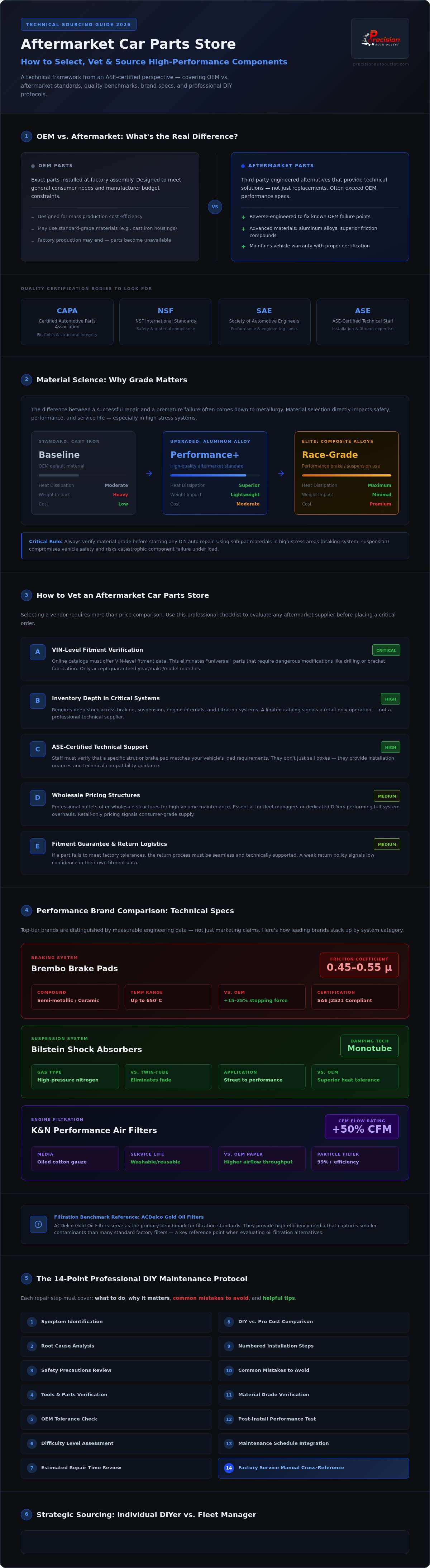
- Analyze technical specifications for top-tier brands, including friction coefficients for Brembo pads and CFM ratings for K&N performance air filters.
- Implement a professional 14-point maintenance protocol to ensure seamless integration and long-term reliability of your new auto parts.
- Discover how strategic sourcing and wholesale distribution can optimize maintenance schedules for both individual DIY mechanics and fleet managers.
The Evolution of Automotive Components: OEM vs. Aftermarket Parts Stores
Automotive engineering relies on a strict distinction between Original Equipment Manufacturer (OEM) parts and aftermarket alternatives. OEM components are the exact parts installed on a vehicle during assembly. They're designed to meet general consumer needs and budget constraints. In contrast, a professional aftermarket car parts store provides components manufactured by third-party companies. These parts aren't just substitutes; they're critical for maintaining vehicles long after factory production ends. The role of the modern store has shifted from simple parts supply to providing technical solutions for specific mechanical failures.
Technical classifications divide these parts into two main categories: standard replacement and performance upgrades. Standard replacement parts aim for parity with the original equipment. Performance upgrades, however, use advanced engineering to correct factory weaknesses or enhance specific capabilities. To ensure quality, professional technicians look for certifications from organizations like the Certified Automotive Parts Association (CAPA), NSF International, and the Society of Automotive Engineers (SAE). These standards verify that the part's fit, finish, and structural integrity match or exceed original requirements. Without these certifications, you risk installing components that don't meet basic safety thresholds.
Material Science: Why Grade Matters
The difference between a successful repair and a premature failure often comes down to metallurgy. Many factory housings use standard cast iron because it's cheap and durable. High-quality aftermarket alternatives frequently switch to aluminum alloys. This change reduces unsprung weight and improves heat dissipation. Tensile strength is another critical factor. Performance components must withstand higher pressure without warping or cracking. Using sub-par materials in high-stress areas like the braking system or suspension compromises vehicle safety. It's essential to verify the material grade before beginning any DIY auto repair to avoid catastrophic component failure under load.
OEM Standards and Aftermarket Interoperability
Aftermarket engineers don't just copy parts; they reverse-engineer them. By analyzing OEM tolerances, they can identify where a component is likely to fail during its service life. This leads to the "better than OEM" phenomenon. In systems like filtration and braking, aftermarket brands often use superior media or friction compounds that the factory couldn't justify due to cost. For example, ACDelco Gold Oil Filters serve as a primary benchmark for filtration standards. They provide high-efficiency media that captures smaller contaminants than many standard factory filters. This level of interoperability ensures that your vehicle maintains its warranty while benefiting from improved protection and performance. Choosing the right aftermarket car parts store ensures you have access to these engineered improvements rather than just basic replacements.
Comparing Aftermarket Car Parts Stores: Technical Benchmarks for Quality
Selecting a vendor requires more than checking price tags. You need a partner with inventory depth in critical systems like braking, suspension, and engine internals. A high-performance aftermarket car parts store provides technical support from ASE-certified staff who understand installation nuances. They don't just sell boxes; they verify that a specific strut or brake pad matches your vehicle's load requirements. Reliability depends on this technical vetting process.
Pricing structures also signal store quality. While retail pricing is standard for one-off repairs, professional outlets offer wholesale structures for high-volume maintenance. This is essential for fleet managers or dedicated DIYers performing full-system overhauls. A store's ability to manage complex return logistics and fitment guarantees is the final benchmark. If a part fails to meet factory tolerances, the return process must be seamless and technically supported.
Vetting the Catalog: Accuracy and Fitment Data
Online catalogs must offer VIN-level fitment verification. This eliminates the guesswork that leads to "universal" parts, which often require dangerous modifications like drilling or bracket fabrication. Stick to components that are guaranteed to match your specific year, make, and model. When you browse a verified technical catalog, you ensure the parts meet the engineering standards your vehicle requires.
| Store Type | Inventory Depth | Support Level | Best For |
|---|---|---|---|
| Big Box Retailer | General/Maintenance | Retail Generalist | Consumables (Wipers, Oil) |
| Specialty Outlet | System-Specific | ASE-Technical | Performance/Complex Repairs |
| Online Marketplace | High/Variable | Minimal/Automated | Price Comparison Only |
Logistics and Technical Reliability
Shipping protocols are a major differentiator for a quality aftermarket car parts store. Components like batteries and fluids are classified as hazardous materials and require specialized handling. A reliable store follows these regulations strictly to prevent damage or delivery delays. Furthermore, evaluate customer service by their troubleshooting capability. If they can't explain the difference between ceramic and semi-metallic friction materials, they aren't equipped to support your repair. For a complete evaluation framework, refer to The DIY Mechanic’s Checklist before making your next purchase.
Performance Brand Analysis: Engineering Standards for Brakes and Filters
Engineering data defines the quality of a component. A technical aftermarket car parts store provides the specific performance data needed to verify brand claims. This analysis focuses on the mechanical attributes of top-tier components. We look at friction coefficients, airflow dynamics, and suspension geometry. These metrics determine how a part will behave under extreme stress. Choosing a brand based on aesthetic appeal is a mistake. You must prioritize material science and verified ratings.
Suspension systems require precise component matching to maintain safety. Bilstein B8 Performance Plus Struts utilize monotube gas pressure technology. These are specifically valved for use with shorter, stiffer springs like Eibach Sportline Lowering Springs. This combination prevents the "bottoming out" common with stock struts on lowered vehicles. Similarly, high-performance lubrication requires specialized filtration. Mobil 1 Synthetic Motor Oil 5W-30 maintains its viscosity at high temperatures, but it needs a high-capacity filter to manage contaminants over extended service intervals.
Braking Systems: Ceramic vs. Semi-Metallic Performance
Brembo Ceramic Brake Pads are engineered for thermal stability. They maintain a consistent friction coefficient even as temperatures rise during repeated stops. This prevents brake fade, which is a dangerous loss of stopping power. Ceramic compounds also produce significantly less abrasive dust than semi-metallic alternatives. This protects your wheel finish and reduces noise. For a deeper look at these specifications, consult the Brembo Ceramic Brake Pads Guide. It details how these pads integrate with high-performance rotors.
| Pad Type | Friction Coefficient | Max Thermal Limit | Dust Production |
|---|---|---|---|
| OEM Organic | 0.25 - 0.35 µ | 400°F | Moderate |
| Brembo Ceramic | 0.38 - 0.45 µ | 700°F | Low |
| Track Grade | 0.50+ µ | 1,200°F+ | High |
Filtration and Engine Health
Filtration efficiency is measured by micron ratings. ACDelco Gold Oil Filters are designed to capture particles as small as 25 to 30 microns. This level of precision protects internal engine bearings from microscopic debris. In the intake system, K&N Performance Air Filters focus on airflow dynamics. They're rated by Cubic Feet per Minute (CFM). Higher CFM ratings allow the engine to pull in more oxygen with less effort. This optimization improves throttle response and combustion efficiency. When sourcing from a professional aftermarket car parts store, always request these technical ratings. High-flow technology only works if the filtration media can still protect the engine from silica and other particulates.
The Professional DIY Protocol: Maintenance Standards and Installation
Precision is mandatory when installing components from an aftermarket car parts store. You can't just "bolt it on" and expect factory-level reliability. Successful integration requires a disciplined 14-point maintenance protocol that starts with diagnostic verification and ends with a verified break-in period. Skipping these technical steps often leads to hardware fatigue or premature component failure. If you're upgrading to high-performance systems like Bilstein struts or Brembo pads, you're dealing with stored energy and hydraulic pressure. Safety is your first priority.
Working with heavy suspension components or pressurized braking systems carries inherent risks. Always use rated jack stands on a level, concrete surface. Never rely on a floor jack to support the vehicle's weight during the repair. When you source from a reliable aftermarket car parts store, you receive parts built to tight tolerances. Maintaining those tolerances during installation requires specialized tools and a calibrated torque wrench. Hand-tightening is never acceptable for critical fasteners.
Installation Workflow: Step-by-Step Execution
-
Diagnostic Verification and Symptom Identification
- What to do: Confirm the mechanical failure through a road test or visual inspection. Compare the dimensions of your new auto parts against the components currently installed on the vehicle.
- Why it matters: Installing parts on a misdiagnosed system leads to wasted labor and potential damage to new components.
- Common mistakes to avoid: Assuming a noise is a brake pad when it's actually a failing wheel bearing.
- Helpful tips: Use a digital caliper to verify the rotor thickness matches the minimum discard limit stamped on the hub.
-
Tool Preparation and Workspace Organization
- What to do: Gather all specialized equipment, including a calibrated torque wrench and a brake piston compressor. Clean your workspace to prevent grit from entering open hydraulic lines.
- Why it matters: Having the right tools prevents stripped fasteners and ensures the repair stays on schedule.
- Common mistakes to avoid: Using an adjustable wrench on high-torque suspension bolts, which can round off the bolt heads.
- Helpful tips: Lay your tools out in the order you'll use them to maintain a methodical repair rhythm.
-
Component Removal and Surface Preparation
- What to do: Remove the old hardware and use a wire brush to strip rust from the hub face and mounting brackets. Apply a thin layer of high-temp brake lubricant to the pad contact points.
- Why it matters: Debris on the hub causes lateral runout, leading to brake pedal pulsation and steering wheel vibration.
- Common mistakes to avoid: Letting a heavy brake caliper hang by the rubber hydraulic hose, which can cause internal liner failure.
- Helpful tips: Use a bungee cord or a dedicated caliper hanger to support the weight of the braking assembly during the repair.
-
Installation and Torquing to Factory Specifications
- What to do: Seat the new component and tighten all fasteners to the exact foot-pounds specified in your factory service manual.
- Why it matters: Proper torque ensures the bolt reaches its "clamping force" without exceeding its elastic limit or snapping.
- Common mistakes to avoid: Using an impact wrench for the final tightening instead of a manual torque wrench.
- Helpful tips: Many 2026 models use "torque-to-yield" bolts that stretch when tightened; these must be replaced with new hardware every time they're removed.
| Tool Category | Essential Item | Technical Purpose |
|---|---|---|
| Precision | Torque Wrench (ft-lb/in-lb) | Ensuring fasteners reach elastic limit without snapping. |
| Support | 6-Ton Jack Stands | Providing a redundant, mechanical safety lock. |
| Hydraulic | Brake Spreader/C-Clamp | Retracting pistons without damaging internal seals. |
| Suspension | Spring Compressor | Safely managing the potential energy in coil springs. |
Estimated Repair Metrics
Consulting a factory service manual is non-negotiable for modern DIY auto repair. A frequent mistake is ignoring the break-in or "bedding" period for new friction materials. This process transfers a thin layer of pad material to the rotor, which is essential for maximum stopping power. Failure to do this can result in glazed pads and permanent brake squeal. Always perform five to ten moderate stops from 40 mph to 10 mph in a controlled environment to set the friction layer.
| Component Upgrade | Difficulty (1-5) | Estimated Time | Cost Comparison (DIY vs. Pro) |
|---|---|---|---|
| Brembo Ceramic Pads | 2 | 1.5 Hours | Save ~60% in Labor |
| Bilstein B8 Struts | 4 | 4.0 Hours | Save ~50% in Labor |
| K&N Air Filter | 1 | 0.2 Hours | Save ~90% in Labor |
Strategic Sourcing: Integrating Aftermarket Components into Maintenance
Transitioning from reactive repairs to a preventative maintenance schedule requires a reliable aftermarket car parts store that prioritizes technical accuracy. High-quality components don't just restore functionality; they preserve the vehicle's long-term resale value and mechanical integrity. By consistently sourcing parts that meet or exceed factory specifications, you ensure the vehicle operates within its designed performance envelope. This strategic approach minimizes the risk of catastrophic system failure and reduces the total cost of ownership over the vehicle's lifecycle. Precision sourcing is an investment in reliability.
Precision sourcing also impacts the secondary market. A vehicle maintained with documented, high-performance aftermarket components often commands a higher price. Buyers recognize the value of brands like Bilstein or Brembo because these names represent a commitment to superior engineering. When you maintain a strict schedule using verified parts, you create a service history that proves the vehicle's structural and mechanical health. It's the difference between a car that's merely running and one that's technically optimized.
Fleet and High-Volume Maintenance
Managing multiple vehicles requires a disciplined approach to inventory and procurement. Professional shops and fleet managers benefit from wholesale distribution models that provide bulk access to critical maintenance supplies. Sourcing high-volume items like Mobil 1 Synthetic Motor Oil, NGK Laser Iridium Spark Plugs, and Bosch Clear Advantage Wiper Blades in larger quantities improves profit margins. A technical aftermarket car parts store acts as a logistics partner, providing the inventory depth required to maintain fleet uptime without the delays associated with retail-level sourcing.
- Inventory Standardization: Using consistent brands across a fleet simplifies maintenance protocols and technician training.
- Bulk Procurement: Reducing per-unit costs for consumables like ACDelco Gold filters and lubrication fluids.
- Technical Documentation: Maintaining a centralized record of component specifications and installation dates for warranty tracking.
Conclusion and Final Recommendation
Technical vetting is always superior to price-based shopping. As we've analyzed, the difference between a successful performance upgrade and a failed repair lies in material science, fitment accuracy, and adherence to professional installation protocols. Whether you're installing Brembo pads or Bilstein struts, the quality of the source determines the reliability of the result. Use this final checklist before your next purchase to ensure you're getting professional-grade hardware.
- Verified VIN-level fitment in the store's digital catalog.
- Confirmed material grades, such as ceramic friction compounds or high-tensile alloys.
- Access to ASE-certified technical guidance for troubleshooting complex installs.
- Clear return logistics and fitment guarantees for DIY projects.
Looking for quality new OEM or aftermarket replacement parts? Precision Auto Outlet offers dependable parts for many makes and models at competitive prices. Browse our catalog to find the right part for your repair.
Optimizing Your Technical Sourcing Strategy
Mastering your vehicle's performance requires moving beyond basic retail transactions. You've learned that technical vetting based on engineering data, such as friction coefficients and micron ratings, is the only way to ensure safety and reliability. By following a structured 14-point installation protocol and sourcing from a specialized aftermarket car parts store, you eliminate the guesswork that often leads to mechanical failure. High-performance components from brands like Brembo and Bilstein aren't just upgrades; they're precise engineering solutions for modern vehicles.
Reliability depends on the quality of your components and the expertise of your source. We provide ASE-certified technical guidance alongside national wholesale and retail logistics to support your repair schedule. As an authorized dealer for Brembo, Bilstein, and ACDelco, we verify that every part in our inventory meets rigorous industry standards. You're now equipped to make informed sourcing decisions that prioritize vehicle longevity and performance over initial cost. Browse our catalog for high-performance aftermarket parts today and elevate your maintenance standards.
Looking for quality new OEM or aftermarket replacement parts? Precision Auto Outlet offers dependable parts for many makes and models at competitive prices. Browse our catalog to find the right part for your repair.
Frequently Asked Questions
Is an aftermarket car parts store better than a dealership for replacement parts?
An aftermarket car parts store is often superior because it offers a wider range of engineering choices than a dealership. While dealers only stock one-size-fits-all factory components, specialized stores provide performance-grade options like Brembo pads or Bilstein struts. These parts frequently exceed original equipment specifications for durability and heat management at a lower price point. You get the flexibility to choose components that match your specific driving habits rather than settling for standard factory limits.
Will using aftermarket parts from a specialized store void my vehicle's manufacturer warranty?
No, using aftermarket components won't void your warranty under federal law unless the manufacturer can prove the specific part caused a failure. Legal protections ensure that you can use any high-quality replacement part for routine maintenance and repairs. To stay protected, always choose certified parts that meet factory standards. Document your purchases and keep detailed records of your maintenance intervals to provide proof of proper vehicle care if you ever need to make a warranty claim.
How do I verify the fitment of aftermarket performance parts before purchasing?
The most accurate way to verify fitment is by using your Vehicle Identification Number (VIN) in the store's digital catalog. This 17-digit code identifies your exact trim level, engine type, and production date. Don't rely on general year and model searches alone, as manufacturers often change specifications mid-year. Always cross-reference the part number with your factory service manual. If you're still unsure, consult with an ASE-certified technician at the store to confirm the component's technical compatibility with your specific chassis.
What are the most important technical specifications to look for in an aftermarket brake pad?
Focus on the friction coefficient, maximum thermal limit, and material composition. For daily driving, ceramic pads like those from Brembo offer a high friction coefficient with low dust and noise. If you're towing or driving in mountainous terrain, look for pads with higher thermal stability to prevent brake fade. Check for the "edge code" printed on the pad, which indicates its friction rating under various temperatures. Ensure the pad is designed for your vehicle's specific gross weight and braking system architecture.
Are performance air filters like K&N worth the investment for a daily driver?
Yes, performance air filters are a cost-effective investment because they're washable and reusable for the life of the vehicle. Unlike disposable paper filters that require frequent replacement, K&N Performance Air Filters utilize high-flow cotton media to improve airflow dynamics. This leads to better throttle response and potentially improved fuel efficiency. They provide high filtration efficiency, which protects your engine from microscopic debris while allowing it to breathe more easily under load. You'll save money on maintenance costs over several years of ownership.
What is the difference between CAPA-certified and standard aftermarket body parts?
CAPA-certified parts undergo rigorous testing to ensure they match the original manufacturer's fit, finish, and structural integrity. These parts are verified for material strength and corrosion resistance, making them safer for collision repairs. Standard aftermarket body parts may lack these certifications, which often results in misaligned panels or thinner metal that dents easily. If you're performing a DIY auto repair on a safety-critical exterior component, always prioritize CAPA or NSF-certified options to maintain the vehicle's structural safety ratings.
Can I buy wholesale automotive supplies from a retail aftermarket store?
Yes, many professional outlets offer tiered pricing structures for fleet managers and independent repair shops. A technical aftermarket car parts store typically provides wholesale accounts that allow for bulk purchasing of high-volume maintenance supplies. Buying items like Mobil 1 Synthetic Motor Oil or NGK Spark Plugs in larger quantities significantly reduces your per-unit cost. This is an essential strategy for managing the maintenance budget of a multi-vehicle fleet or a busy professional garage while ensuring you always have critical parts in stock.
How do I calculate the ROI of DIY repair vs. taking my car to a professional shop?
Calculate your ROI by subtracting the cost of the parts from the total professional estimate and dividing that number by your estimated repair time. If a shop quotes $400 for labor on a two-hour job, your "hourly savings" is $200. You should also factor in the cost of any specialized tools required for the repair. These tools usually pay for themselves after just one or two uses. If the repair requires expensive diagnostic equipment you don't own, the ROI might favor the professional shop for that specific task.


