
One in four vehicle owners purchased performance products or accessories in 2025, yet many DIY projects stall because of technical complexity. You likely want to improve your vehicle's handling and power, but the high cost of professional installation often stands in the way. Sourcing performance car accessories Dallas enthusiasts trust requires more than just a credit card; it requires technical literacy. It's common to feel overwhelmed by confusing specifications or the fear of choosing incompatible parts for your specific make and model.
This guide provides the professional-grade technical insights needed to master the selection and installation of high-performance components. You'll learn to execute DIY repairs with confidence, using the same protocols employed by ASE-certified technicians. We'll cover everything from Texas-specific regulations, such as the 85-decibel exhaust limit, to the precise installation of components like Bilstein B8 struts and MagnaFlow exhaust systems. This structured approach moves you from broad concepts to granular mechanical specifics, ensuring your vehicle performs exactly as engineered.
Key Takeaways
- Differentiate between aesthetic modifications and functional mechanical upgrades when sourcing performance car accessories Dallas professionals use for measurable power gains.
- Optimize engine efficiency by analyzing the relationship between K&N Performance Air Filters, intake restriction, and air-to-fuel ratios.
- Improve stopping power through the installation of Brembo ceramic brake pads, focusing on thermal stability and friction material performance.
- Master suspension engineering by integrating Bilstein B8 struts with Eibach Sportline lowering springs for enhanced handling and cornering stability.
- Execute technical upgrades using professional-grade DIY protocols and cost comparison data to ensure high-performance results without professional labor fees.
The Fundamentals of Performance Car Accessories and Upgrades
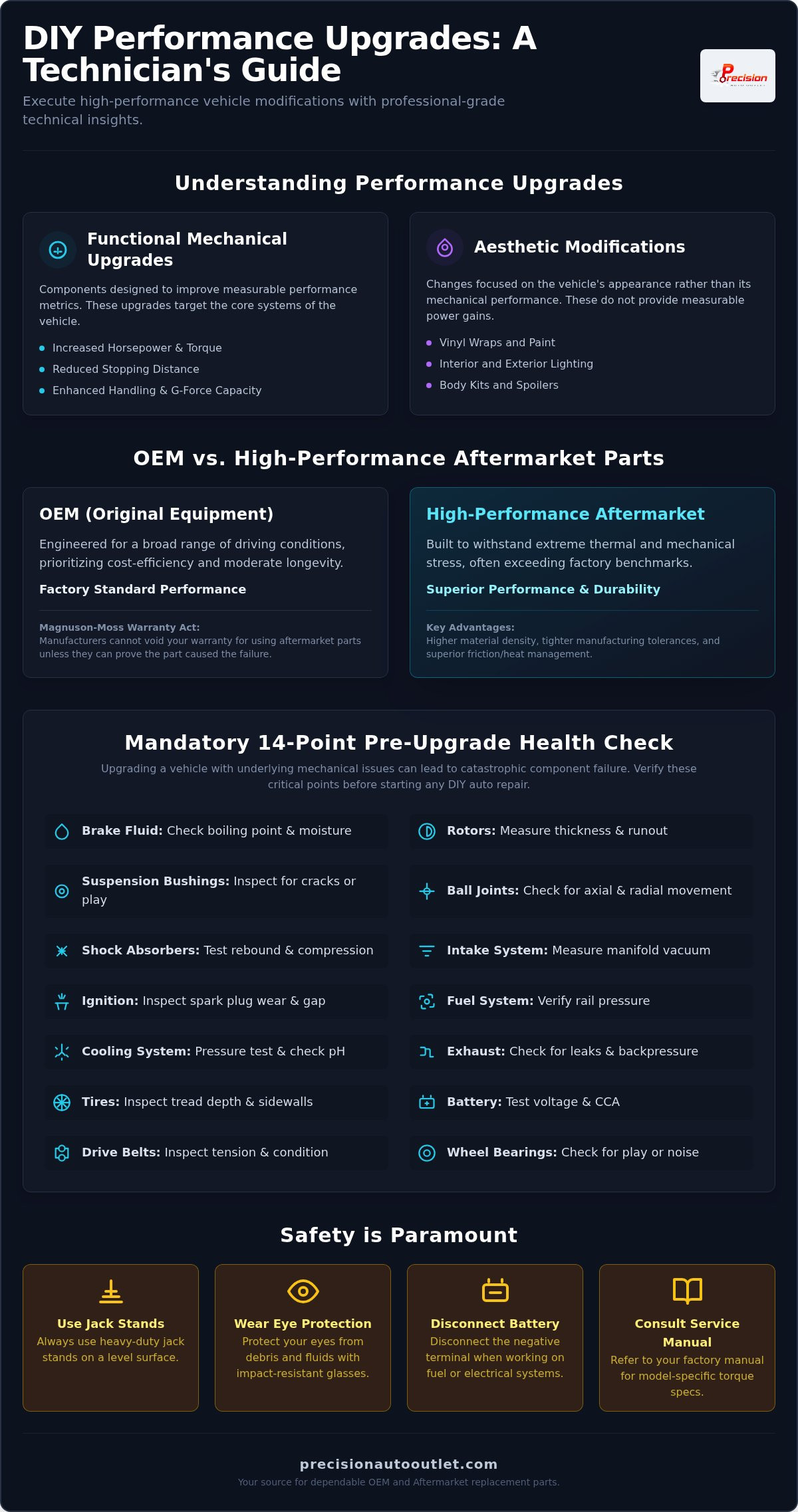
Performance car accessories are functional components designed to improve the mechanical efficiency, thermal stability, or kinetic response of a vehicle's engine, braking, and suspension systems. Unlike aesthetic modifications like vinyl wraps or interior lighting, performance upgrades target measurable metrics such as horsepower, torque, stopping distance, and lateral G-force capacity. Understanding The Fundamentals of Performance Car Accessories is essential for any technician or enthusiast looking to exceed standard factory benchmarks. When sourcing performance car accessories Dallas drivers should prioritize parts that offer higher material density and tighter manufacturing tolerances than standard components.
OEM vs. Aftermarket Performance Standards
Original Equipment Manufacturer (OEM) parts are engineered for a broad range of driving conditions, prioritizing cost-efficiency and moderate longevity. High-performance aftermarket parts are built to withstand extreme thermal and mechanical stress. For instance, drivers often choose Brembo Ceramic Brake Pads because they offer superior friction management and heat dissipation compared to stock semi-metallic pads. It's a common misconception that aftermarket parts void vehicle warranties. Under the Magnuson-Moss Warranty Act, manufacturers cannot deny warranty coverage simply because an aftermarket part was installed, unless they can prove the part caused the specific failure.
The 14-Point Performance Inspection Checklist
Before beginning a DIY auto repair or upgrade, a comprehensive health check is mandatory. Upgrading a vehicle with underlying mechanical issues can lead to catastrophic component failure. Look for symptoms like excessive brake fade, uneven tire wear, or engine hesitation. These often stem from worn standard components or vacuum leaks. Before installing new auto parts, verify these 14 critical points:
- Brake fluid: Check boiling point and moisture content.
- Rotors: Measure thickness and surface runout.
- Suspension bushings: Inspect for cracking or play.
- Ball joints: Check for axial and radial movement.
- Shock absorbers: Test rebound and compression rates.
- Intake system: Measure manifold vacuum pressure.
- Ignition: Inspect spark plug electrode wear and gap.
- Fuel system: Verify rail pressure at idle and load.
- Cooling system: Perform a pressure test and check pH levels.
- Exhaust: Check for leaks and excessive backpressure.
- Tires: Inspect tread depth and sidewall integrity.
- Battery: Test voltage and cold cranking amps (CCA).
- Drive belts: Inspect tension and rib condition.
- Wheel bearings: Check for excessive play or noise.
Safety is paramount during this process. Always use heavy-duty jack stands, wear impact-resistant eye protection, and disconnect the negative battery terminal when working on electrical or fuel systems. Consult your factory service manual for model-specific torque specifications to ensure all performance car accessories Dallas installations meet engineering standards.
Optimizing Engine Efficiency with Air and Ignition Components
Volumetric efficiency is the ratio of air-fuel mixture entering the cylinder compared to its static volume. High-performance engine tuning relies on optimizing this ratio to increase power. When sourcing performance car accessories Dallas technicians prioritize the intake and ignition systems to eliminate factory bottlenecks. Restricted airflow and weak spark are primary causes of performance loss. Symptoms of these issues include sluggish throttle response, reduced fuel economy, and engine misfires under high load.
K&N Performance Air Filter Integration
K&N Performance Air Filters utilize multiple layers of oil-treated cotton gauze. This design allows for higher CFM (cubic feet per minute) airflow than standard paper filters while maintaining high filtration standards. Reducing intake restriction ensures the engine doesn't work harder than necessary to draw in oxygen. Understanding Sourcing and Maintaining High-Performance Accessories is vital for ensuring your intake modifications meet federal standards while delivering peak output.
Follow these steps to replace a factory air filter with a high-flow element:
- Loosen the housing clamps or clips on the factory air box using a screwdriver or socket.
- Remove the restrictive paper filter and inspect the air box for debris.
- Clean the interior of the intake housing with a lint-free cloth to prevent contaminants from reaching the engine.
- Install the high-flow filter, ensuring the rubber seal sits flush against the housing edges.
- Re-secure the housing clamps and verify there are no air leaks downstream of the filter.
Common Mistake: Avoid over-oiling the filter during cleaning cycles. Excess oil can migrate to the Mass Air Flow (MAF) sensor, causing erratic idling or "limp mode" errors.
NGK Laser Iridium Spark Plug Specifications
NGK Laser Iridium Spark Plugs feature a fine-wire center electrode that provides superior thermal conductivity. Iridium has a melting point of approximately 4,429 degrees Fahrenheit, which allows the plug to withstand extreme combustion temperatures without electrode erosion. This durability ensures a consistent spark and prevents the fouling often seen in standard copper plugs. You can find dependable NGK Laser Iridium Spark Plugs to ensure your ignition system handles increased cylinder pressures.
To gap performance spark plugs, use a wire-style feeler gauge. Never use a coin-style gapper on iridium tips; the prying motion can snap the delicate center electrode. Always consult your factory service manual for specific torque values. Over-tightening can crack the ceramic insulator, while under-tightening leads to poor heat transfer and potential plug blowout.
| Component/Tool | Technical Specification | Primary Function |
|---|---|---|
| K&N Performance Air Filter | High-flow cotton gauze | Reduces intake restriction |
| NGK Laser Iridium Plugs | 0.6mm Iridium tip | Ensures consistent ignition |
| Wire Feeler Gauge | Precision measurement | Sets electrode gap |
| Torque Wrench | Inch-pound/Foot-pound | Prevents thread damage |
| MAF Sensor Cleaner | Quick-dry solvent | Removes oil/contaminants |
Performance Braking Systems: Brembo Ceramic Technology
The thermal stability of Brembo ceramic friction materials represents a significant technical upgrade over standard organic or semi-metallic compounds. These pads utilize a proprietary blend of ceramic fibers and non-ferrous materials to maintain a consistent friction coefficient at elevated temperatures. When evaluating performance car accessories Dallas drivers must consider the extreme heat cycles typical of North Texas stop-and-go traffic. Ceramic pads resist "heat soak," ensuring the braking system remains responsive even after repeated high-speed decelerations.
| Metric | Ceramic (Brembo) | Semi-Metallic |
|---|---|---|
| Cost | Higher Initial Investment | Lower Initial Cost |
| Noise | Minimal / Near-Silent | Audible / Moderate Squeal |
| Dust | Low / Non-Corrosive | High / Metallic Residue |
| Heat Stability | High (Resists Fade) | Moderate (Prone to Fade) |
Diagnosing Brake Fade and Component Fatigue
Brake fade occurs when the friction material or brake fluid exceeds its thermal operating limit. Symptoms include a spongy pedal feel or a noticeable increase in stopping distances. Glazed rotors, identified by a mirror-like blue tint on the surface, are a common cause of performance loss. This happens when pads overheat and deposit a hardened layer of resin onto the rotor. Checking brake fluid boiling points is critical for performance setups. Moisture-contaminated fluid boils at a lower temperature, causing vapor lock and total pedal failure under load. Sourcing high-quality performance car accessories Dallas retailers provide ensures your hydraulic system can handle these thermal demands.
Step-by-Step Performance Brake Pad Installation
Executing a professional-grade brake service requires specific tools: a torque wrench, caliper piston retractor, brake cleaner, and high-temp silicone lubricant. While the vehicle is raised, it's an ideal time for a full maintenance check; refer to our guide on ACDelco Gold Oil Filters for engine-side protocols. Follow these numbered steps for installation:
- Secure the vehicle: Loosen lug nuts, lift the car using a floor jack, and place it on heavy-duty jack stands.
- Remove the caliper: Unbolt the caliper mounting bolts and suspend the caliper using a bungee cord to avoid straining the rubber brake line.
- Retract the piston: Use a caliper spreader tool to compress the piston back into its bore, allowing room for the thicker new pads.
- Clean and lubricate: Scrub the rotor surfaces with brake cleaner. Apply a thin layer of high-temp lubricant to the caliper slide pins and the back of the new pads.
- Install and torque: Seat the new Brembo pads into the bracket. Reinstall the caliper and tighten bolts to the factory torque specifications found in your service manual.
Common Mistakes: Don't forget to pump the brake pedal several times before driving to reset the piston position. Neglecting to lubricate slide pins often leads to uneven pad wear and sticking calipers.
The final stage is the "bedding-in" process. This involves a series of controlled stops from 35-45 mph to transfer an even layer of friction material from the pad to the rotor surface. This transfer layer is essential for maximizing the lifespan and stopping power of your new performance components.
Suspension Engineering: Bilstein and Eibach Integration
The synergy between Bilstein B8 Performance Plus struts and Eibach Sportline lowering springs is a benchmark in automotive suspension engineering. While standard struts often bottom out when paired with shorter springs, the Bilstein B8 is specifically shortened to maintain full piston travel with a lowered ride height. This combination utilizes monotube gas pressure technology. Unlike twin-tube designs, monotube struts feature a larger piston area for more precise damping and superior heat dissipation. When selecting performance car accessories Dallas enthusiasts should prioritize this integration to achieve a lower center of gravity without sacrificing ride quality or mechanical longevity.
Suspension geometry is defined by three primary alignment angles: camber, caster, and toe. Camber is the inward or outward tilt of the tire when viewed from the front; negative camber improves cornering grip by keeping the tire contact patch flat during lateral loading. Caster refers to the angle of the steering axis, which influences straight-line stability and steering return. Toe describes whether the front of the tires point toward or away from each other. Precise control over these angles is necessary to prevent premature tire wear and erratic handling after installing new auto parts.
| Component Replacement | Difficulty Level | Estimated Time (Per Axle) | Specialty Tools Required |
|---|---|---|---|
| Front Strut Assembly | Moderate / High | 2.5 - 4 Hours | Spring Compressor, Impact Wrench |
| Rear Shocks / Springs | Moderate | 1.5 - 2.5 Hours | Floor Jack, Jack Stands |
| Sway Bar End Links | Low | 0.5 - 1 Hour | Wrench Set, Penetrating Oil |
Identifying Suspension Wear and Handling Issues
Worn suspension components manifest as excessive body roll during cornering or "nose-diving" under heavy braking. These symptoms often result from blown strut seals or sagging factory spring rates. Uneven tire wear, particularly "cupping" on the inner tread, indicates the dampers can no longer control wheel oscillation. Before beginning a DIY auto repair, consult your factory service manual for specific alignment tolerances. Installing high-performance Bilstein B8 Performance Plus Struts can resolve these instabilities by providing a more consistent damping rate across various road surfaces.
Performance Strut and Spring Installation Protocol
Safe suspension modification requires a methodical approach and the use of heavy-duty equipment. Follow these steps for a successful installation:
- Secure the chassis: Use a floor jack to lift the vehicle and place it on four heavy-duty jack stands. Never work under a car supported only by a jack.
- Compress the springs: Use a high-quality spring compressor to relieve tension on the upper strut mount. This is a high-energy component; ensure the compressor claws are seated securely.
- Assemble the strut unit: Slide the Eibach Sportline spring onto the Bilstein B8 strut body. Ensure the spring ends are seated correctly in the lower and upper isolator perches.
- Install and hand-tighten: Guide the assembly into the tower and secure the top nuts. Reattach the steering knuckle and sway bar links using new hardware if recommended by the manufacturer.
- Torque at ride height: Lower the vehicle onto its wheels before final tightening. Tightening suspension bushings while the car is in the air causes "pre-loading," which leads to premature bushing failure and erratic ride height.
Maintenance Tip: Periodically inspect dust boots and bump stops for tears. Debris entering the strut shaft can score the internal seals, leading to fluid leaks and a loss of pressurized nitrogen gas.
Sourcing and Maintaining High-Performance Accessories
Optimizing vehicle performance requires a disciplined approach to component selection and long-term maintenance. When sourcing performance car accessories Dallas enthusiasts must prioritize parts that balance power gains with regulatory compliance. For example, MagnaFlow Performance Exhaust Systems utilize mandrel-bent tubing to maintain a constant internal diameter through every curve. This engineering choice reduces backpressure and improves scavenging efficiency compared to standard crush-bent pipes. In Texas, all aftermarket exhaust modifications must adhere to a 85-decibel noise limit, making high-quality stainless steel systems a preferred choice for both durability and legal operation.
| Upgrade Type | Professional Labor (Est. Hours) | DIY Difficulty | Maintenance Interval |
|---|---|---|---|
| Performance Exhaust | 2.0 - 4.0 Hours | Moderate | Annual Hanger Inspection |
| Brake Pad Replacement | 1.5 - 2.5 Hours | Moderate | Every 12,000 Miles |
| Strut & Spring Install | 5.0 - 8.0 Hours | High | Every 20,000 Miles |
| Air Filter Service | 0.5 Hours | Low | Every 50,000 Miles |
A performance-modified vehicle operates under higher mechanical stress than a stock commuter car. To ensure reliability, you should follow a specialized maintenance schedule. This includes checking for exhaust leaks at the flange gaskets and inspecting the integrity of rubber hangers every 10,000 miles. Under the Texas "Right to Repair" law (HB2963), manufacturers are required to provide the documentation and tools necessary for these repairs. This legislation empowers you to perform complex DIY auto repair tasks while maintaining high technical standards.
MagnaFlow Exhaust and Emission System Maintenance
MagnaFlow systems often feature 409 or 304 stainless steel construction, which provides excellent resistance to the corrosive effects of heat and moisture. When installing these systems, ensure the high-flow catalytic converters are positioned correctly to maintain emission compliance. Maintenance involves more than just listening for a change in tone. You should periodically inspect the welds for stress fractures and verify that the system has at least one inch of clearance from all fuel lines and suspension components. Sourcing performance car accessories Dallas drivers trust means choosing components that offer a lifetime of service through superior material density.
Selecting the Right Components for Your Build
Successful builds are the result of matching specific parts to your primary driving goals. A street-focused build might prioritize the quiet efficiency of Bosch Clear Advantage wiper blades and the comfort of Bilstein struts. Conversely, a track-oriented setup requires the aggressive friction management of Brembo ceramic pads. Sourcing from a provider with a deep technical inventory ensures you receive components that meet exact engineering tolerances. Precision Auto Outlet serves as a dependable partner by providing the high-register technical data needed for informed decision-making.
Looking for quality new OEM or aftermarket replacement parts? Precision Auto Outlet offers dependable parts for many makes and models at competitive prices. Browse our catalog to find the right part for your repair.
Mastering Your Vehicle's Performance Potential
Achieving superior vehicle dynamics requires a move beyond simple bolt-on parts. You've learned that true performance stems from the precise integration of high-quality hardware like K&N air filters, Brembo ceramic pads, and Bilstein B8 struts. By following technical DIY protocols and understanding suspension geometry, you can bypass high professional labor costs while ensuring your modifications meet strict Texas safety and noise regulations. Sourcing performance car accessories Dallas enthusiasts trust is the final step in transforming a standard commuter into a high-output machine. Proper maintenance of these components, such as checking exhaust hanger integrity and monitoring brake fluid boiling points, ensures your investment remains reliable for years to come.
Looking for quality new OEM or aftermarket replacement parts? Precision Auto Outlet offers dependable parts for many makes and models at competitive prices. Browse our catalog to find the right part for your repair.
With the right tools and professional-grade insights, you're now equipped to take full control of your vehicle's technical upgrades and long-term maintenance.
Frequently Asked Questions
Do performance car accessories void my vehicle manufacturer warranty?
No, your warranty remains intact under the federal Magnuson-Moss Warranty Act when you install performance car accessories Dallas retailers provide. A vehicle manufacturer cannot legally deny warranty coverage unless they can prove that the specific aftermarket part caused the mechanical failure in question. It's best practice to keep all receipts and documentation for your new auto parts to ensure a clear service history if a dispute occurs.
What is the most cost-effective performance upgrade for a daily driver?
Replacing a restrictive factory air filter with a high-flow K&N Performance Air Filter is the most cost-effective way to improve engine efficiency. This modification allows for higher airflow volumes, which can lead to better throttle response for a low initial investment. Upgrading to NGK Laser Iridium spark plugs is another affordable way to ensure consistent ignition and prevent power loss caused by electrode wear.
How much time does it typically take to install performance lowering springs?
Installing a complete set of Eibach Sportline lowering springs usually takes between 5 and 8 hours for a DIY auto repair enthusiast. The front suspension requires more time because you must use a spring compressor to safely disassemble the strut units. Rear spring installation is generally faster, though the total time depends on whether your vehicle uses a solid axle or an independent multi-link suspension system.
Can I install Brembo ceramic brake pads on factory rotors?
Yes, you can install Brembo ceramic pads on factory rotors provided the rotors are within the manufacturer's thickness specifications. You must inspect the rotors for deep grooves or warping before the installation begins. For the best results, have your rotors surfaced or "turned" at a local machine shop to ensure the new ceramic friction material transfers evenly during the bedding-in process.
What tools are essential for a beginner DIY performance car project?
An accurate torque wrench, a set of heavy-duty jack stands, and a high-quality metric socket set are the most essential tools for any performance project. These items allow you to secure components to exact factory specifications and work safely under the vehicle. You should also have a factory service manual for your specific model to verify the correct torque values and fluid capacities before you start.
Why should I choose iridium spark plugs over standard copper ones?
Iridium spark plugs are superior because they have a much higher melting point and better durability than copper plugs. The fine-wire iridium tip allows for a more concentrated spark, which improves combustion efficiency even under high-stress driving conditions. While copper plugs are cheaper, they wear out much faster and require more frequent gaps checks to prevent engine misfires and poor fuel economy.
Is a professional alignment necessary after installing new struts?
A professional four-wheel alignment is absolutely necessary after you install new Bilstein B8 struts or any other suspension parts. Replacing these components changes your vehicle's camber, caster, and toe angles. If you don't get an alignment, your tires will wear out prematurely and the car might pull to one side, which makes the handling feel unpredictable and unsafe at high speeds.
How do I know if a performance air filter is compatible with my MAF sensor?
You can verify compatibility by checking the filter manufacturer's application guide for your specific engine code and model year. Most high-flow filters are designed to work perfectly with factory Mass Air Flow (MAF) sensors without causing error codes. When you perform maintenance, it's critical to avoid over-oiling the filter, as excess oil can blow onto the MAF sensor wire and cause the engine to run poorly.


