

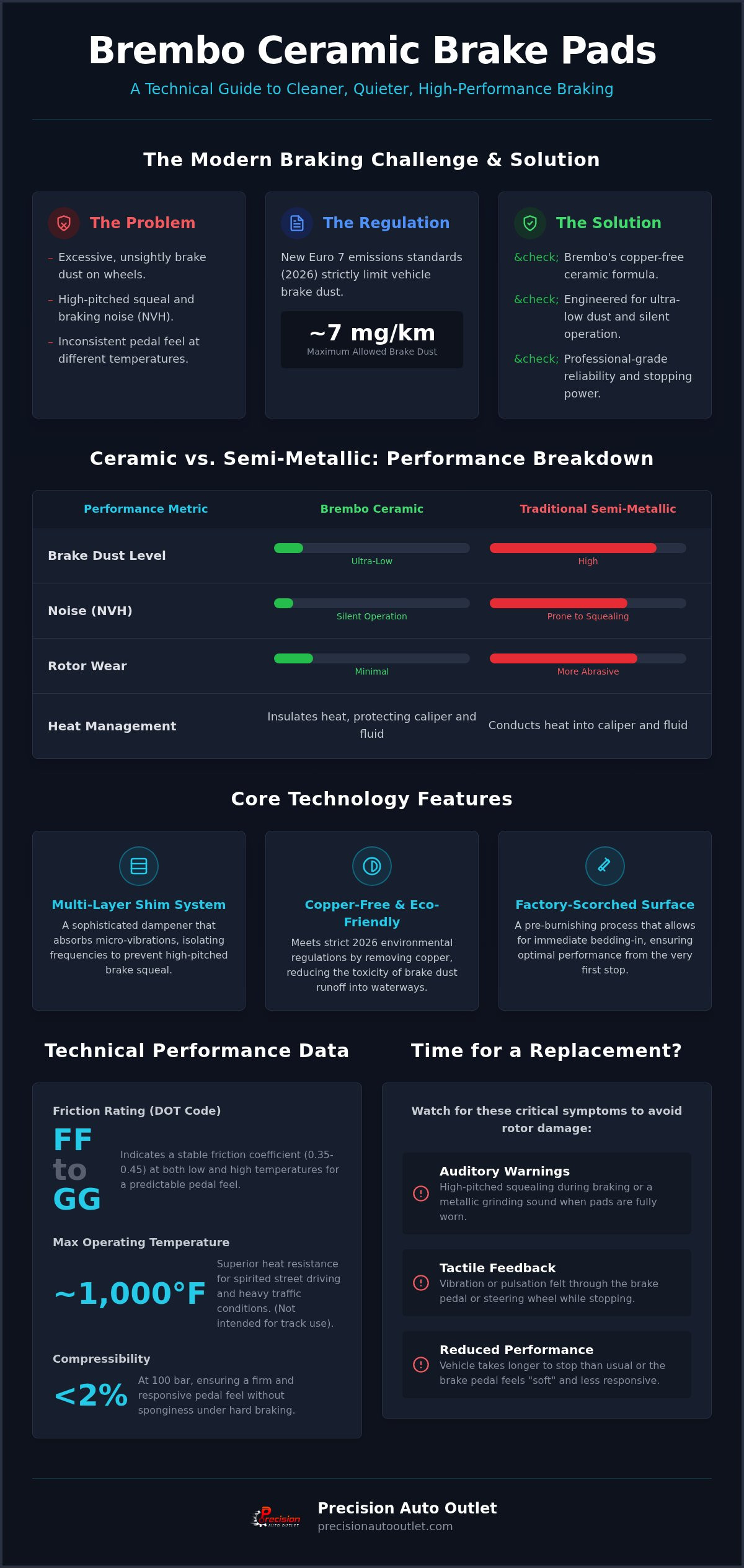
Did you know that under the 2026 Euro 7 emissions standards, passenger vehicle brake dust is now strictly limited to approximately 7 mg/km? This regulation makes selecting the correct friction material a technical necessity rather than a cosmetic choice. It's frustrating to see premium wheels coated in thick residue or to hear a piercing squeal during cold morning starts. Most drivers want the confidence of a firm pedal without the maintenance headaches of traditional semi-metallic pads. Upgrading to Brembo Ceramic Brake Pads solves these issues by utilizing a copper-free, low-emission formula designed for silent operation and professional-grade reliability.
You'll learn to identify critical diagnostic symptoms and master the technical specifications required for a successful brake service. We'll provide a comprehensive, step-by-step installation guide that mirrors factory service manual procedures. This overview covers the tools you'll need, safety precautions; and the specific bedding process required for ceramic materials. By following this technical resource, you'll ensure your braking system operates at peak efficiency while keeping your wheels clean and your stops silent.
Key Takeaways
- Learn how multi-layer shim technology and ceramic compounds work together to eliminate brake squeal and excessive wheel dust.
- Identify the specific auditory and tactile symptoms that signal it's time for a brake pad replacement to avoid costly rotor damage.
- Master the step-by-step procedure for installing Brembo Ceramic Brake Pads, including a complete list of required tools and torque specifications.
- Understand the critical bedding-in process to ensure your new friction material transfers correctly for maximum stopping power and reliability.
- Compare professional versus DIY repair costs and timelines to plan your vehicle maintenance with surgical precision.
Understanding Brembo Ceramic Friction Technology
Brembo Ceramic Brake Pads represent a significant shift from traditional friction materials used in older automotive applications. While standard semi-metallic pads rely on a high percentage of steel wool and iron powder, ceramic formulations use dense ceramic fibers and non-ferrous fillers. This material science is fundamental to how a modern Brake pad manages friction and heat. Ceramic compounds are specifically engineered to provide a consistent coefficient of friction across a broad range of operating temperatures. This stability ensures that your stopping distance remains predictable, whether the brakes are cold during a morning commute or hot after repeated stops in heavy traffic.
Noise, vibration, and harshness (NVH) reduction is a primary engineering goal for Brembo. To achieve this, these pads feature a sophisticated multi-layer shim system. This component acts as a specialized dampener, absorbing the micro-vibrations that occur when the pad contacts the rotor. By isolating these frequencies, the system prevents the high-pitched squeal often associated with high-performance braking. Additionally, Brembo utilizes a copper-free formula to meet strict 2026 environmental regulations. This isn't just about compliance; removing copper reduces the toxicity of brake dust runoff into local waterways, making it a technically superior choice for the modern eco-conscious driver.
Ceramic vs. Semi-Metallic: A Technical Comparison
The primary technical difference lies in thermal conductivity. Semi-metallic pads conduct heat quickly, often transferring high temperatures into the brake calipers and fluid. Ceramic pads act more like an insulator. They keep heat focused on the rotor surface where it can be dissipated by the cooling vanes. This process is gentler on cast iron surfaces, leading to significantly lower rotor wear over the life of the vehicle. Additionally, the dust morphology of ceramic material is distinct. The particles are lighter in color and don't adhere to expensive alloy rims with the same intensity as metallic dust, which often etches into wheel finishes.
The Brembo Prime Series Engineering
The Brembo Prime series incorporates several specific design features to enhance out-of-the-box performance. You'll notice a distinctive metal grey backplate, which is treated to resist corrosion and manage heat dissipation. Each pad also features a scorched surface. This factory process pre-burnishes the friction material, allowing for immediate bedding and optimal performance from the first stop. When paired with UV-coated rotors, this system provides a comprehensive solution for longevity and professional-grade reliability.
Technical Specifications and Material Science
The technical performance of Brembo Ceramic Brake Pads is defined by their friction coefficient ratings, commonly identified by two-letter DOT codes found on the pad edge. Most Brembo ceramic formulations carry an "FF" or "GG" rating. These letters represent the friction coefficient at both low and high temperatures. An "FF" rating indicates a stable friction level between 0.35 and 0.45, providing a consistent bite regardless of whether you're starting a cold vehicle or driving on a hot afternoon. This stability is critical for maintaining a predictable brake pedal feel, which is often compromised in cheaper aftermarket alternatives that suffer from high-temperature compressibility.
Material transfer is the process where a thin layer of friction material adheres to the rotor surface. For optimal performance, these pads are designed to operate within a specific thermal window, typically reaching peak efficiency between 200 and 600 degrees Fahrenheit. While they are not intended for heavy track use like dedicated Carbon ceramic brakes, they offer superior heat resistance for spirited street driving. Additionally, the ceramic compound is significantly lighter than low-steel or semi-metallic counterparts. This reduction in unsprung mass improves suspension response and overall handling dynamics. If you're looking to upgrade your entire corner assembly, you might consider pairing these with high-performance struts to maximize the benefits of reduced component weight.
Brembo Ceramic Performance Data Table
| Metric | Specification | Dust Level | Ideal Use Case |
|---|---|---|---|
| Friction Rating | FF to GG | Ultra-Low | Daily Commuting |
| Max Operating Temp | Approx. 1,000°F | Minimal | Spirited Road Use |
| Compressibility | <2% at 100 bar | N/A | Precision Braking |
Technical precision is also evident in the physical construction of the pad backing. Brembo utilizes a specific high-carbon rotor pairing strategy to ensure that the friction material wears evenly and resists glazing. This interaction prevents the "spongy" pedal feel that occurs when inferior materials compress under hydraulic pressure.
Advanced Shim and Adhesive Technology
The black shim on the rear of the pad isn't just a cover; it's a multi-layered dampening system. Brembo uses a specialized adhesive layer that remains flexible at extreme temperatures, preventing the shim from migrating or delaminating during heavy use. Unlike standard pads that rely solely on chemical bonding, these pads often feature mechanical retention systems like NUCAP technology. This system uses hundreds of tiny hooks to lock the friction material to the steel backplate, ensuring the pad remains intact even under severe thermal stress. This mechanical bond is a hallmark of professional-grade reliability and safety.
Diagnostic Guide: When to Replace Your Brake Pads
Identifying the need for new brake components requires a methodical approach. Visual inspection remains the most reliable method for assessing the health of your braking system. Most technicians recommend replacement once the friction material reaches 3mm; this is the critical threshold for safety. Below this measurement, the pad's ability to dissipate heat diminishes rapidly. This increases the risk of brake fade and can lead to the backing plate making direct contact with the rotor surface. When inspecting Brembo Ceramic Brake Pads, you should look for even wear across the inner and outer pads. Uneven wear often points to mechanical issues within the caliper assembly rather than a fault in the friction material itself.
Diagnostic symptoms typically manifest as either auditory or tactile cues. Modern pads often include mechanical wear indicators. These small metal tabs create a high-pitched squeal when they contact the rotor, signaling that the friction material is nearly exhausted. If you experience a pulsating pedal or steering wheel shake during deceleration, it usually indicates lateral rotor runout or uneven pad deposits. Premature wear is frequently caused by external factors such as caliper sticking or distorted rotors. A seized caliper piston prevents the pad from retracting, which causes constant friction and excessive heat buildup. Addressing these underlying issues is essential before installing new aftermarket auto parts to ensure professional-grade longevity.
Symptom and Cause Troubleshooting Table
| Observed Symptom | Probable Technical Cause | Required Action |
|---|---|---|
| High-pitched squeal | Mechanical wear sensor contact | Replace pads immediately |
| Steering wheel vibration | Lateral rotor runout | Inspect or replace rotors |
| Vehicle pulls to one side | Seized caliper piston or slide pin | Service or replace caliper |
| Grinding noise | Backing plate contact (0mm material) | Full system inspection required |
Brake System Maintenance Protocols
A successful brake service involves more than just swapping parts. You must check the brake fluid's hygroscopic levels during every pad replacement. Brake fluid absorbs moisture over time, which lowers its boiling point and can lead to a spongy pedal feel. Additionally, you should inspect the caliper slide pins for lubrication failure. Use a high-temperature silicone-based grease to ensure the caliper moves freely. Finally, always measure the rotor thickness with a micrometer. Compare your findings against the minimum discard specifications stamped on the rotor hat. If the rotor is below the limit, it cannot safely handle the heat generated by new Brembo Ceramic Brake Pads.
Step-by-Step Installation: DIY Brembo Pad Replacement
Performing a brake service at home is a practical way to ensure your vehicle receives professional-grade attention. Installing Brembo Ceramic Brake Pads is a manageable task for those with moderate mechanical skill and the correct equipment. You should expect the process to take between 1.5 and 3 hours per axle. Taking your time ensures that every component is cleaned and torqued to factory specifications, which prevents the common issues of noise and vibration.
| Required Tool or Supply | Technical Purpose |
|---|---|
| Metric Socket Set | Removing caliper mounting bolts and lug nuts |
| C-clamp or Piston Tool | Retracting caliper pistons for new pad clearance |
| Torque Wrench | Applying specific factory fastener tension |
| High-Temp Brake Lube | Lubricating slide pins and metal contact points |
| Service Method | Estimated Cost | Primary Benefit |
|---|---|---|
| Professional Shop | $400+ | Labor warranty and convenience |
| DIY Replacement | $120 - $180 | Significant savings and quality control |
The Installation Procedure
- Vehicle Lifting and Safety: Loosen the lug nuts while the tires are on the ground. Raise the vehicle using a hydraulic jack and secure it on safety stands. Never work on a vehicle supported only by a jack; safety stands are required to prevent catastrophic failure.
- Caliper Removal: Remove the mounting bolts and slide the caliper off the rotor. Use a bungee cord or mechanic's wire to secure the caliper to the suspension. Do not let it hang by the rubber brake hose. This causes internal damage and potential fluid leaks.
- Surface Preparation: Use a wire brush to clean the hub and rotor interface. Any rust or debris trapped here can cause lateral runout and pedal pulsation. Ensure the new Brembo Ceramic Brake Pads have a perfectly flat surface for optimal contact and heat dissipation.
- Component Lubrication: Apply a thin layer of high-temp brake lubricant to the metal ears of the pads and the caliper slide pins. Avoid getting any grease on the friction face of the pad or the rotor surface, as this will contaminate the material and reduce braking power.
Before you begin your repair, ensure you have all the necessary DIY auto repair supplies on hand to avoid mid-project delays.
Common Installation Mistakes to Avoid
- Neglecting the Brake Pedal: You must pump the brake pedal several times after installation before moving the vehicle. This action resets the caliper pistons against the new friction material. Failure to do this results in no braking power on the first application.
- Reusing Degraded Hardware: Anti-rattle clips and return springs lose their tension over time. Always use the new hardware included with your kit to prevent pad movement and unwanted noise.
- Surface Contamination: Keep your hands clean or wear fresh gloves when handling the pads. Greasy fingerprints on the friction material can lead to glazing and reduced stopping performance. Clean the rotors with brake cleaner before final assembly.
Optimization and Maintenance for Performance Braking
The final stage of a professional brake service is the burnishing process. This step is critical for Brembo Ceramic Brake Pads because it establishes a uniform transfer layer of friction material on the rotor face. Without this layer, the pads will experience localized hot spots. This leads to uneven wear and the pedal pulsation often mistaken for warped rotors. A successful bedding-in procedure ensures that the friction occurs between the pad and the transfer layer rather than directly against the raw cast iron of the rotor. This interaction is what provides the silent operation and low-dust benefits expected from premium ceramic compounds.
Total vehicle health requires a holistic approach to maintenance. While you are servicing the braking system, it is an ideal time to inspect other consumable components. Integrating high-quality parts like ACDelco Gold Oil Filters into your maintenance schedule ensures that your engine remains as protected as your stopping system. For drivers who transition from daily commuting to occasional track-day applications, understand that ceramic pads have thermal limits. If your driving style involves sustained high-speed braking, upgrading to Brembo Low-Met compounds may be necessary to handle the increased thermal loads, despite the trade-off in dust production.
The 30-30-30 Bedding-In Protocol
To set the transfer layer correctly, follow the 30-30-30 technical procedure. Perform 30 decelerations from 30 MPH down to 5 MPH using moderate pressure. You should allow approximately 30 seconds between each application to prevent the pads from overheating before the material has stabilized. Do not come to a complete stop during these cycles; keeping the vehicle in motion prevents the hot pad from leaving a physical imprint on the rotor surface. Avoid panic stops or heavy ABS engagement for the first 200 miles of service. A successful transfer layer will appear as a light gray or slightly blue haze across the swept area of the rotor.
System Synergy: Rotors and Fluid
Brembo Ceramic Brake Pads achieve peak performance when paired with high-carbon rotors. The increased carbon content improves thermal conductivity and works to dampen the high-frequency vibrations that cause brake squeal. Additionally, the choice of brake fluid affects pedal modulation. While DOT 4 is standard for most vehicles, upgrading to a high-performance DOT 5.1 fluid provides a higher boiling point and more consistent pressure during spirited driving. Before returning the vehicle to service, perform a final inspection using this checklist:
- Verify all caliper mounting bolts are torqued to factory specifications.
- Ensure the brake fluid reservoir is filled to the "Max" line with fresh, uncontaminated fluid.
- Check that all wheel lug nuts are tightened in a star pattern to prevent rotor distortion.
- Confirm the brake pedal is firm and does not travel excessively toward the floor.
Looking for quality new OEM or aftermarket replacement parts? Precision Auto Outlet offers dependable parts for many makes and models at competitive prices. Browse our catalog to find the right part for your repair.
Achieving Professional-Grade Braking Results
Upgrading to Brembo Ceramic Brake Pads ensures your vehicle meets 2026 environmental standards while providing a silent, low-dust driving experience. Success relies on accurate diagnostic measurements and following the 30-30-30 bedding-in protocol. These technical steps guarantee a consistent transfer layer and long-term rotor protection. Precision Auto Outlet acts as your partner in this process; providing ASE-certified technical guidance and a comprehensive inventory of performance-matched components. Our national shipping network delivers premium friction materials directly to your door, ensuring you have the exact parts required for a professional-grade repair. As performance integration experts, we're confident that high-quality friction material is the foundation of vehicle safety and wheel aesthetics. You're now able to maintain your vehicle with the same precision as a professional technician while enjoying the tangible benefits of dust-free rims and reliable stopping power.
Looking for quality new OEM or aftermarket replacement parts? Precision Auto Outlet offers dependable parts for many makes and models at competitive prices. Browse our catalog to find the right part for your repair.
Frequently Asked Questions
Are Brembo Ceramic brake pads better than OEM pads?
Brembo Ceramic Brake Pads are often superior to standard OEM pads because they prioritize low-dust emissions and noise reduction. While factory pads are designed for a broad range of generic conditions, these ceramic versions use advanced friction materials to keep wheels cleaner and operation quieter. They provide a more consistent pedal feel during daily commuting and spirited street driving compared to many factory-installed semi-metallic alternatives.
Do Brembo Ceramic pads require special rotors?
These pads do not require specialized rotors, but they perform most efficiently when paired with high-carbon or UV-coated rotors. Standard cast iron rotors are fully compatible. However, high-carbon rotors provide better thermal conductivity and help dampen the vibrations that cause brake squeal. Ensuring your rotors meet the minimum thickness specifications is more important than the specific rotor brand for achieving professional-grade results.
Why are my new Brembo Ceramic pads squeaking?
Squeaking usually indicates that the bedding-in protocol was not followed or that the contact points were not properly lubricated. If you skipped the 30-30-30 burnishing process, the essential transfer layer of friction material hasn't formed on the rotor surface. You should also check the caliper slide pins and the metal ears of the pads to ensure they have a thin coating of high-temperature brake lubricant.
How long do Brembo Ceramic brake pads typically last?
The service life of these pads generally ranges from 30,000 to 70,000 miles, though this varies based on your specific driving environment. Ceramic compounds are denser and more resistant to wear than organic or semi-metallic materials. Highway driving typically extends the lifespan toward the higher end of this range. Frequent stop-and-go city traffic or heavy braking will accelerate the wear process and require more frequent inspections.
Can I use Brembo Ceramic pads for track days?
No, you should not use Brembo Ceramic Brake Pads for track applications because they are not designed for extreme thermal loads. These pads are optimized for street comfort, low noise, and minimal dust. The intense heat generated during track sessions can cause ceramic material to glaze or suffer from significant brake fade. For track use, you should install Brembo Low-Met or dedicated racing pads that handle much higher temperatures.
What is the difference between Brembo Ceramic and Low-Met pads?
The primary difference lies in the material composition and the intended use case. Ceramic pads use dense ceramic fibers to minimize dust and noise for daily street use. Low-Met pads contain a higher percentage of metal, which provides better friction at extreme temperatures but results in more wheel dust and occasional squealing. Choose ceramic for a clean and quiet commute, but select Low-Met for high-performance or heavy-duty applications.
Do I need to bleed my brakes when changing pads?
You don't necessarily need to bleed the brakes during a simple pad swap unless the hydraulic system was opened or the pedal feels spongy. It's a technical best practice to inspect the brake fluid for moisture contamination during the service. If the fluid appears dark or if the vehicle hasn't had a fluid flush in over two years, performing a full bleed ensures the new pads operate with maximum hydraulic efficiency.
Are Brembo Ceramic pads copper-free?
Yes, Brembo Ceramic Brake Pads are manufactured using a copper-free formula to comply with 2026 environmental regulations. This design meets the strict Euro 7 standards for reduced particulate emissions. By removing copper, Brembo has reduced the toxicity of brake dust runoff into local waterways. This technical shift ensures that the pads remain compliant with global environmental mandates while maintaining the high friction stability required for modern safety systems.


