
Why would you pay a premium for NGK Laser Iridium Spark Plugs when standard iridium or platinum alternatives are available for less? It's a common question for DIYers facing engine misfires or a sudden drop in fuel economy. Many vehicle owners believe that any spark plug will do, but modern high-compression engines require more than a basic arc. If you've dealt with rough idling or confusion over heat ranges, you're likely seeing the performance limits of standard ignition components.
This guide will help you master your vehicle's ignition system by analyzing why these specific components are necessary to meet the 55 mpg CAFE targets for 2026. We'll examine the technical advantages of the 98% pure copper core and the dual-precious metal design featuring an iridium center electrode and platinum ground electrode. You can expect a deep dive into technical specifications followed by a step-by-step installation process to ensure your engine runs at peak efficiency while maintaining strict emissions compliance.
Key Takeaways
- Learn the engineering advantages of the 0.6mm fine-wire center electrode and laser-welded platinum chip for maximum durability.
- Understand why NGK Laser Iridium Spark Plugs are essential for maintaining 2026 fuel economy standards and preventing engine misfires.
- Master a professional-grade installation protocol including essential safety steps and the correct tools for a successful DIY auto repair.
- Identify the performance differences between OE-replacement Laser Iridium components and enthusiast-grade Iridium IX options.
- Discover how to synchronize your ignition maintenance with oil changes to optimize combustion efficiency and engine longevity.
Identifying Spark Plug Failure and the NGK Laser Iridium Solution
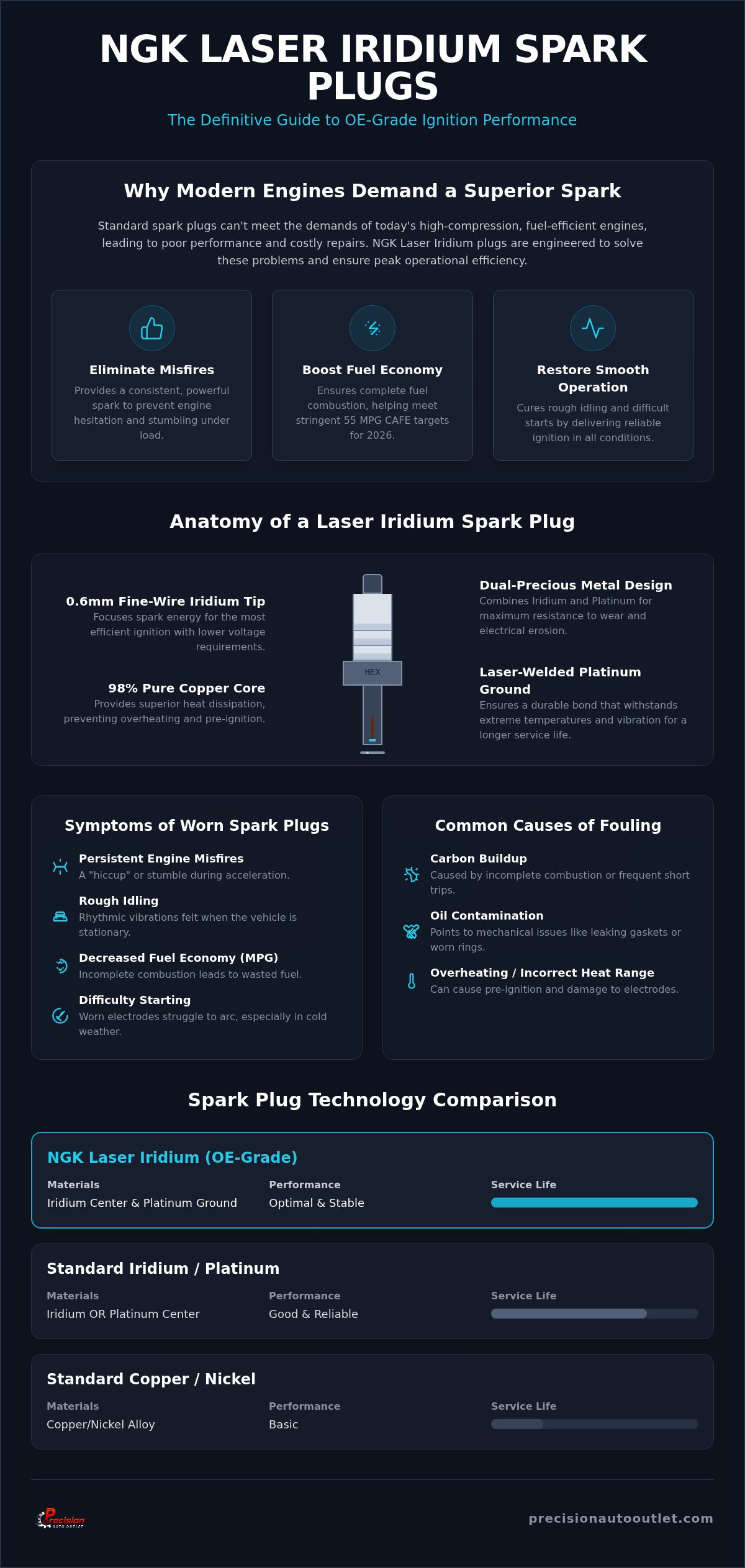
NGK Laser Iridium Spark Plugs represent the pinnacle of original equipment (OE) ignition technology. These components utilize a laser-welded iridium center electrode and a platinum disc on the ground electrode. This dual-precious metal construction ensures maximum longevity and stable spark delivery under extreme thermal conditions. Before upgrading, understanding spark plug fundamentals is essential for any technician or enthusiast. The spark plug is the final stage of the ignition circuit. It's responsible for initiating the combustion event that powers your engine. When these parts fail, the entire powertrain's efficiency collapses.
Ignition timing directly impacts engine health and tailpipe emissions. In modern vehicles, precise combustion is required to meet the 55 mpg CAFE targets for 2026. If the spark is weak or delayed, unburned fuel enters the exhaust system. This increases emissions and can damage expensive catalytic converters. NGK Laser Iridium Spark Plugs are the preferred choice for high-temperature, high-compression engines because they maintain a consistent gap even after millions of ignition cycles. For those performing a DIY auto repair, identifying failure early is the key to avoiding costly secondary repairs.
Common Symptoms of Worn Ignition Components
Worn plugs rarely fail all at once. Instead, they exhibit progressive symptoms that degrade the driving experience. Watch for these specific indicators:
- Persistent engine misfires: You'll feel this as a "hiccup" or stumble, especially under heavy load or during rapid acceleration.
- Significant decrease in MPG: As electrodes wear, they require higher voltage to fire. This leads to incomplete combustion and wasted fuel.
- Difficulty starting: Worn electrodes struggle to arc in cold, dense air, leading to longer cranking times during winter months.
- Rough idling: You'll notice rhythmic vibrations through the steering wheel or seat while the vehicle is stationary.
Primary Causes of Spark Plug Fouling
Fouling occurs when the firing tip is coated with foreign substances. This prevents the plug from reaching its self-cleaning temperature. Common causes include:
- Carbon buildup: This often results from incomplete combustion or low-quality fuel. Frequent short trips where the engine doesn't reach full operating temperature also contribute to this.
- Oil contamination: This is a mechanical red flag. It usually points to leaking valve cover gaskets or worn piston rings allowing oil into the combustion chamber.
- Overheating: This typically results from an incorrect heat range selection. If the plug runs too hot, it can cause pre-ignition and eventual electrode melting.
Technical Specifications: Engineering the NGK Laser Iridium Series
The performance of NGK Laser Iridium Spark Plugs begins with the 0.6mm fine-wire center electrode. Unlike standard copper or large-diameter platinum plugs, this narrow iridium tip focuses electrical discharge into a more concentrated area. This precision engineering allows for a more efficient spark with lower voltage requirements from the ignition coil. By utilizing iridium, which has a melting point of approximately 4,429 degrees Fahrenheit, the electrode maintains its shape and gap integrity even under the extreme pressures of high-compression 2026 engines. This stability is critical for preventing misfires and ensuring the engine reaches its full power potential.
A primary differentiator for this series is the laser-welded platinum chip located on the ground electrode. While many plugs use a standard nickel alloy for the ground, NGK incorporates platinum to combat electrical erosion. This dual-precious metal configuration creates a more durable ignition path. The laser welding process ensures a permanent bond that survives the thermal expansion and contraction cycles of a combustion chamber. This specific architecture is why these components are often categorized as premium aftermarket replacement auto parts that match or exceed original equipment specifications.
Fine-Wire Electrode Technology and Ignitability
Smaller electrode diameters significantly improve ignitability by reducing the "quenching effect." Quenching occurs when the large mass of a standard electrode absorbs heat from the initial spark, potentially extinguishing the flame kernel before it can spread. The 0.6mm design of NGK Laser Iridium Spark Plugs minimizes this heat loss. This results in faster flame propagation and more consistent throttle response. Recent advancements in spark plug technology highlight how these fine-wire designs are essential for cold-start reliability and lean-burn efficiency. Drivers typically experience more immediate engine turnover and smoother acceleration as a result of this improved spark efficiency.
Durability Standards and Anti-Corrosion Features
Durability is anchored by the use of high-grade alumina silicate ceramic insulators. This material provides superior dielectric strength and thermal conductivity to dissipate heat away from the firing tip. To protect the external shell, NGK applies a trivalent metal plating. This specialized coating offers exceptional resistance to moisture and chemical corrosion. It also prevents the spark plug from seizing in the cylinder head, a common issue in aluminum heads that undergo frequent heat cycles. For technicians and DIYers, this means easier removal at the 100,000-mile service interval. If you are sourcing professional-grade ignition components, verifying these anti-seize properties is vital for long-term engine maintenance.
Performance Analysis: Laser Iridium vs. Alternative Spark Plug Types
Choosing the correct ignition component requires understanding the distinction between longevity and raw performance. NGK Laser Iridium Spark Plugs are engineered as original equipment (OE) replacements. They prioritize a 100,000-mile service life through a dual-precious metal design. In contrast, the Iridium IX series is designed for performance enthusiasts. While Iridium IX offers excellent ignitability, it lacks the platinum ground electrode disc found in the Laser Iridium line, leading to a shorter maintenance interval. For drivers following strict precision auto parts standards, the Laser Iridium series provides the most stable long-term integration for modern engine management systems.
Modern coil-on-plug (COP) systems demand specific internal resistance to function correctly. Standard copper plugs offer high conductivity but wear quickly, increasing the gap and straining the ignition coils. Platinum plugs offer better longevity than copper but don't match the melting point or hardness of iridium. NGK Laser Iridium Spark Plugs bridge this gap by providing the highest durability while maintaining the precise resistance needed to prevent Radio Frequency Interference (RFI). This protects sensitive engine control modules from electrical noise that can cause erratic sensor readings or software glitches.
Ignition Efficiency and Fuel Economy Comparison
Precise ignition timing is vital for maintaining the 55 mpg CAFE targets set for 2026. Laser Iridium technology stabilizes the flame kernel, which is especially important in lean-burn engines where the air-fuel mixture is harder to ignite. This stability results in a smoother idle and more efficient fuel burn during cruising speeds. The table below compares the functional attributes of common electrode materials.
| Electrode Material | Conductivity | Melting Point | Service Life (Est.) |
|---|---|---|---|
| Copper | High | 1,984°F | 20,000 - 30,000 Miles |
| Platinum | Medium | 3,215°F | 60,000 Miles |
| Iridium | Low-Medium | 4,429°F | 80,000 - 100,000 Miles |
Cost-Benefit Analysis: Professional vs. DIY Replacement
Performing a DIY auto repair on your ignition system can lead to significant savings, though difficulty varies by engine layout. Inline-four engines typically offer easy access to all cylinders. Transverse-mounted V6 engines often require the removal of the intake manifold to reach the rear bank of plugs. Understanding these requirements helps you plan for the necessary tools and time.
| Vehicle Configuration | Estimated DIY Time | Difficulty Level | Pro Labor Hours |
|---|---|---|---|
| Inline 4 Cylinder | 45 Minutes | Low | 1.0 Hour |
| V6 (Transverse) | 3.0 Hours | High | 2.5 Hours |
| V8 (Rear Drive) | 1.5 Hours | Moderate | 2.0 Hours |
Installation Protocol: Step-by-Step NGK Spark Plug Replacement
Proper installation ensures that your NGK Laser Iridium Spark Plugs deliver the durability discussed in previous sections. Precision is mandatory. Begin by gathering the necessary equipment for a successful DIY auto repair. You must allow the engine block to cool completely before starting. Aluminum cylinder heads are prone to thread damage when warm. Disconnect the negative battery terminal to prevent electrical grounding issues during the process. Before removing the old plugs, clean the area around the ignition coils with compressed air. This prevents dirt from falling into the combustion chamber. Finally, inspect each ignition coil boot for cracks or carbon tracking.
Essential Tools and Safety Precautions
You need a calibrated torque wrench and a dedicated spark plug socket with a rubber insert. The insert protects the ceramic insulator from cracking. Never use impact drivers or power tools. These tools lack the sensitivity required for delicate threads. If you feel resistance while removing a plug, stop. Apply a small amount of penetrating oil and wait. During removal, check the coil boots for signs of heat damage. Brittle boots can cause voltage leaks and misfires. Secure your engine's performance by sourcing OEM-quality NGK components today.
Step-by-Step Gapping and Torquing Procedures
Follow these steps to complete the installation safely. Accuracy at this stage prevents engine damage and ensures optimal combustion.
Step 1: Verify the factory gap setting. NGK Laser Iridium Spark Plugs are generally pre-gapped at the factory. However, shipping vibrations can occasionally alter this. Use a wire-style gap gauge to confirm the measurement matches your engine's specifications. Why it matters: An incorrect gap causes weak sparks or high-voltage strain on the coils. Common mistake: Using a coin-style gapper. This can snap the fragile 0.6mm iridium center electrode. Helpful tip: If adjustment is needed, only bend the ground electrode. Never touch the center wire.
Step 2: Hand-thread the plug into the cylinder head. Place the plug into the socket and extension. Lower it into the spark plug well and spin it clockwise by hand until it seats. Why it matters: This ensures the threads are properly aligned. Common mistake: Starting the process with a ratchet. This often leads to cross-threading, which requires expensive cylinder head removal to fix. Helpful tip: Use a short length of vacuum hose over the top of the plug for better feel and reach in deep wells.
Step 3: Apply final torque with a calibrated wrench. Set your torque wrench to the value specified in your service manual. Stop immediately when the wrench clicks. Why it matters: Proper torque ensures a gas-tight seal and efficient heat dissipation into the head. Common mistake: Over-torquing. This can stretch the metal shell or cause it to shear off inside the engine. Helpful tip: Do not use anti-seize unless the manufacturer specifically recommends it. NGK's trivalent plating already provides corrosion protection.
Maintenance Standards and Integration with Precision Auto Parts
Peak engine performance requires a holistic approach to the combustion environment. While NGK Laser Iridium Spark Plugs provide high durability, their efficiency depends on the quality of lubrication and filtration. Using Mobil 1 Synthetic Motor Oil 5W-30 reduces the presence of sludge and carbon precursors that otherwise foul electrode tips. Clean oil, supported by high-efficiency ACDelco Gold Oil Filters, ensures that the piston rings maintain a tight seal. This prevents oil from entering the combustion chamber and causing the fouling symptoms described in the first section of this guide.
Air filtration is equally critical for ignition longevity. A clogged or low-quality air filter allows abrasive particulates to enter the cylinders. These particles act as sandblasting agents against the fine-wire iridium electrode, which prematurely wears the 0.6mm tip. To meet the 2026 CAFE targets of 55 mpg, every component in the intake and ignition chain must function at its design specification. Neglecting one part of the system will eventually degrade the performance of your premium ignition components.
Long-Term Maintenance Tips for Ignition Systems
Although these plugs are rated for 100,000 miles, a visual inspection every 30,000 miles is a professional standard. This allows you to "read" the engine's internal health. A light tan or gray deposit on the insulator indicates a healthy engine. Black, sooty deposits suggest a rich fuel mixture or restricted airflow. Oily residues point toward mechanical wear in the valve guides or piston rings. When you eventually replace your plugs, replace the ignition coils in complete sets. This maintains electrical balance across the cylinder bank and prevents old coils from straining the new plugs.
Selecting the Correct Heat Range for Your Vehicle
The NGK numbering system is an essential technical detail for any DIY auto repair involving performance modifications. In this system, a higher number indicates a "colder" plug that dissipates heat faster. For example, a heat range 7 plug runs cooler than a range 5. Standard street vehicles should always use the factory-specified heat range to prevent carbon fouling during city driving. However, turbocharged engines or those with increased compression may require a colder plug. This prevents pre-ignition and catastrophic engine knock. Always consult your factory service manual before deviating from the stock heat range.
Looking for quality new OEM or aftermarket replacement parts? Precision Auto Outlet offers dependable parts for many makes and models at competitive prices. Browse our catalog to find the right part for your repair.
Optimizing Your Ignition System for the Road Ahead
Maintaining engine efficiency in 2026 requires a focus on precision and high-grade components. By installing NGK Laser Iridium Spark Plugs, you equip your vehicle with the dual-precious metal technology needed to withstand extreme thermal pressures. Success in any DIY auto repair depends on following exact torque specifications and ensuring your ignition maintenance is integrated with quality lubrication and filtration. This comprehensive approach prevents the fouling and misfires that compromise modern fuel economy standards.
Precision Auto Outlet supports your maintenance goals with ASE-certified technical support and national shipping on all OEM-quality parts. We offer competitive pricing for individual DIYers and wholesale distribution for professional repair shops looking for reliable inventory. Browse our full catalog of NGK Laser Iridium Spark Plugs at Precision Auto Outlet to secure the components your engine requires. With the right parts and procedures, you'll keep your vehicle running at peak efficiency for another 100,000 miles.
Looking for quality new OEM or aftermarket replacement parts? Precision Auto Outlet offers dependable parts for many makes and models at competitive prices. Browse our catalog to find the right part for your repair.
Frequently Asked Questions
Are NGK Laser Iridium spark plugs pre-gapped from the factory?
Yes, NGK Laser Iridium Spark Plugs are pre-gapped at the factory to meet the specific requirements of the vehicle application. You should still verify the gap with a wire-style gauge before installation to account for potential shipping damage. Don't use a coin-style gapper because it can snap the fragile 0.6mm iridium tip. If the gap is incorrect, only adjust the ground electrode to avoid damaging the center wire.
How long do NGK Laser Iridium spark plugs actually last?
These plugs typically last up to 100,000 miles under normal driving conditions. The dual-precious metal construction, featuring an iridium center electrode and a platinum-tipped ground electrode, provides exceptional resistance to electrical erosion. This longevity is significantly higher than standard copper or platinum alternatives. Regular inspections every 30,000 miles help ensure the engine's combustion environment remains healthy and doesn't lead to premature fouling or wear.
Can I use Laser Iridium plugs in an older car that originally used copper?
You can generally use these premium plugs in older vehicles that originally came with copper components. The fine-wire iridium design requires less voltage to fire, which can actually reduce the load on older ignition coils. This upgrade often results in more reliable cold starts and smoother idling. Always cross-reference the heat range and thread dimensions to ensure the new plug matches the original factory specifications for your specific engine.
What happens if I over-torque a spark plug during installation?
Over-torquing a spark plug can cause the metal shell to stretch or shear off entirely in the cylinder head. This creates a risk of compression leaks and poor heat transfer from the plug to the engine block. In extreme cases, the ceramic insulator may crack, leading to internal electrical shorts and persistent misfires. Always use a calibrated torque wrench to reach the exact foot-pound or inch-pound value specified in your vehicle's factory service manual.
Do NGK Laser Iridium plugs require anti-seize on the threads?
NGK Laser Iridium Spark Plugs don't require the use of anti-seize during installation. The metal shells feature a special trivalent plating that provides superior corrosion resistance and prevents seizing in aluminum cylinder heads. Applying anti-seize can act as a lubricant, leading to false torque readings and accidental over-tightening. If you choose to use it, you must reduce the target torque value by approximately 20 percent to prevent thread damage.
Why is my engine still misfiring after installing new NGK spark plugs?
Persistent misfires after a fresh installation often point to damaged ignition coil boots or faulty spark plug wires. If a boot was cracked during removal, voltage will leak to the engine block instead of reaching the plug. Ensure all electrical connectors are fully seated and free of corrosion. You should also verify that the plugs weren't dropped during installation, as even a small impact can close the gap or crack the internal ceramic.
What is the difference between NGK Iridium IX and Laser Iridium?
The primary difference lies in their intended service life and ground electrode design. Laser Iridium is an OE-style plug with a platinum chip on the ground electrode for a 100,000-mile service interval. Iridium IX is a performance-oriented plug with a tapered nickel alloy ground electrode. While Iridium IX offers excellent ignitability for enthusiasts, it lacks the platinum reinforcement and typically requires replacement every 40,000 to 50,000 miles.
How do I find the correct NGK part number for my specific vehicle?
The most reliable method is to use the NGK online part finder or consult your vehicle's factory service manual. You'll need your vehicle's year, make, model, and engine displacement. In some cases, the VIN is necessary to identify mid-year production changes. Precision Auto Outlet provides an integrated catalog where you can find the exact part number for your repair, ensuring you receive the correct heat range and reach for your specific engine.


