
Your expensive ceramic coating is only as effective as the mechanical decontamination that precedes it. If you've ever finished a ten-hour job only to find holograms or chemical staining, you've experienced the gap between consumer products and high-grade professional car detailing supplies. It's frustrating to waste time and resources on results that look worse than when you started. These setbacks usually stem from improper tool selection or incorrect pH levels.
We'll bridge that gap by helping you master the technical selection and application of chemicals for a true concours-level finish. You'll learn how to identify the specific requirements for different surfaces and understand the physics behind paint correction. This guide provides a repeatable protocol covering everything from Meguiar's Gold Class Car Wash application to advanced abrasive cycles; this ensures you achieve showroom results every time you step into the garage.
Key Takeaways
- Understand the technical distinctions between consumer-grade products and professional car detailing supplies, focusing on chemical concentration and mechanical durability.
- Learn why maintaining a neutral pH balance is critical for surface preservation and how surfactants encapsulate contaminants to prevent paint marring.
- Master the mechanics of paint correction by identifying the correct abrasive technology and choosing between rotary or dual-action polishers based on surface distress.
- Establish a repeatable technical protocol to identify paint defects and implement a workflow that maximizes efficiency through professional bulk sourcing.
Categorizing Professional Detailing Supplies by Functional Application
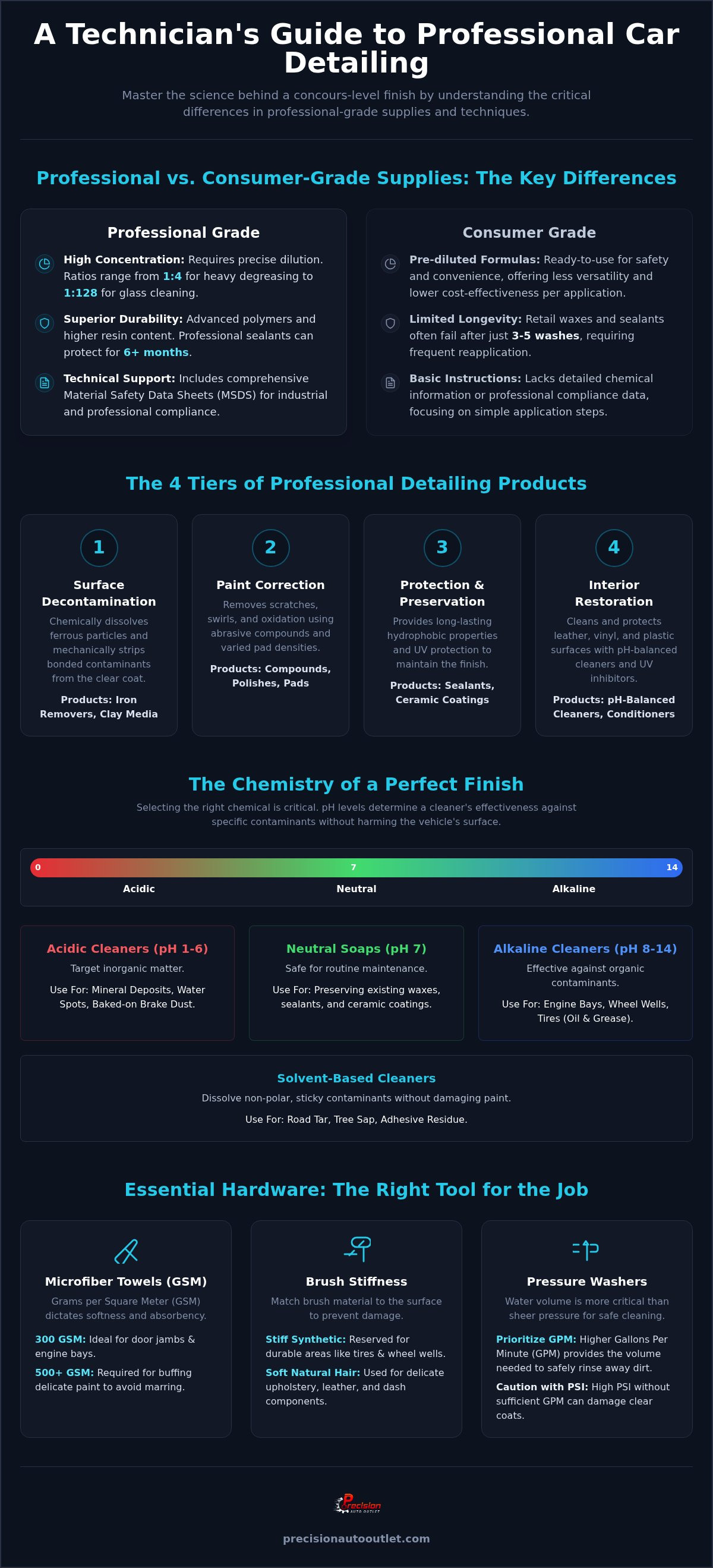
Auto detailing at a professional level is a systematic engineering process. It relies on a tiered classification of inventory to ensure surface safety and efficiency. Unlike standard retail options, professional car detailing supplies are defined by high chemical purity and mechanical durability. This organization allows technicians to select tools with surgical precision based on the specific material substrate they're treating.
- Tier 1: Surface Decontamination. This includes chemical iron removers that dissolve ferrous particles and mechanical clay media used to strip bonded contaminants from the clear coat.
- Tier 2: Paint Correction and Leveling. These are abrasive compounds and varied pad densities, such as microfiber or foam, designed for removing scratches and oxidation.
- Tier 3: Protection and Preservation. This tier covers synthetic sealants, ceramic coatings, and high-grade polymers that provide hydrophobic properties and UV protection.
- Tier 4: Interior Restoration. These products focus on pH-balanced cleaners and UV inhibitors to maintain the integrity of leather, vinyl, and high-tech plastic surfaces.
The Difference Between Consumer and Professional Grades
Retail products are often pre-diluted for safety and ease of use. Professional-grade chemicals arrive in high-concentration formats. This requires technicians to master specific dilution ratios. These ratios can range from 1:4 for heavy degreasing to 1:128 for glass cleaning. Concentrated formulas provide better value and lower environmental impact through reduced packaging. Professional supplies also include comprehensive technical support and Material Safety Data Sheets (MSDS) for industrial compliance. The durability standards are significantly higher. A professional sealant might protect a surface for six months. A retail wax may fail after just three washes. This longevity is a result of higher resin content and advanced chemical cross-linking.
Essential Hardware for Professional Detailing
Hardware selection depends on the mechanical requirements of the surface. Microfiber towels are categorized by Grams per Square Meter (GSM). A 300 GSM towel is ideal for door jambs and engine bays. You need a 500 GSM or higher towel for buffing paint to avoid marring delicate surfaces. Brush stiffness is another critical factor. Stiff synthetic brushes are reserved for tires and wheel wells. Soft natural hair brushes are used for delicate upholstery and dash components. When selecting a pressure washer, prioritize Gallons Per Minute (GPM) over PSI. A higher GPM provides the water volume needed to safely rinse away encapsulated dirt. High PSI without sufficient volume can actually damage clear coats or force water into sensitive electrical components.
Chemical Engineering in Detailing: pH-Neutral Soaps vs. Heavy-Duty Degreasers
Effective detailing is rooted in chemistry. Professional car detailing supplies are formulated with specific pH levels to target different types of debris without compromising the vehicle's substrate. The pH scale ranges from 0 to 14. A value of 7 is neutral. Most maintenance washes require pH-neutral soaps to ensure that existing waxes, sealants, or ceramic coatings aren't stripped away during the cleaning process.
- Alkaline Cleaners (pH 8-14): These are effective against organic contaminants. Use these degreasers for engine bays, wheel wells, and tire sidewalls where oil and grease accumulate.
- Acidic Solutions (pH 1-6): These target inorganic matter. They're essential for dissolving mineral deposits, water spots, and baked-on brake dust that alkaline cleaners cannot touch.
- Solvent-Based Cleaners: These are used for non-polar contaminants. They dissolve road tar, tree sap, and adhesive residue by breaking the chemical bond without damaging the underlying clear coat.
Lubrication and Encapsulation Technology
Modern wash systems rely on advanced polymers to protect the paint. These polymers encapsulate dirt particles, lifting them into suspension so they don't scratch the finish during agitation. Meguiar's Gold Class Car Wash is a benchmark for this. It provides high-lubricity foam that maintains a protective barrier between the wash mitt and the clear coat. Surfactants are chemical compounds that reduce the surface tension of water, allowing it to spread and penetrate contaminants more effectively. If you're looking to stock your shop, you can find these high-performance detailing chemicals in bulk sizes for better cost efficiency.
Chemical Decontamination: Iron Removers and Clay Lubricants
Iron removers target ferrous fallout from brake pads and industrial rail dust. These products use a chemical reaction that turns purple upon contact with iron oxide. This process makes invisible contaminants visible and water-soluble. Following chemical treatment, mechanical decontamination using a clay bar removes any remaining bonded grit. You must use a dedicated clay lubricant during this step. It creates a thin film that prevents the clay from grabbing the paint and causing marring. Because these industrial chemicals are often aggressive, they're subject to the Federal Hazardous Substances Act (FHSA) for labeling and safety. Always wear appropriate personal protective equipment (PPE) and work in a well-ventilated area when handling concentrated acids or solvents.
Mechanical Agitation and Correction Tools for Paint Restoration
Mechanical correction is the process of leveling the clear coat to remove light-refracting defects. Professional car detailing supplies in this category include high-torque machines and engineered abrasives. The primary mechanical distinction lies between rotary and Dual Action (DA) polishers. Rotary machines use a direct-drive rotation that generates significant heat. This is efficient for heavy defect removal but requires expert control to avoid paint burn. DA polishers employ a random orbital pattern. This motion mimics hand-polishing but at higher speeds; it significantly reduces the risk of holograms and heat-related damage.
Abrasive technology further dictates the workflow. Diminishing Abrasive Technology (DAT) uses particles that fracture and become smaller as you work. This allows a single compound to start with a heavy cut and finish with high clarity. Conversely, Super Micro Abrasive Technology (SMAT) uses non-diminishing particles that stay the same size. SMAT provides a consistent cut throughout the cycle. The International Detailing Association provides technical certification resources that help technicians master these abrasive cycles for various paint types.
Selecting the Correct Polishing Pad
Pad selection must match the abrasive and the paint hardness. Selecting the correct pad is a fundamental part of managing professional car detailing supplies for maximum efficiency. Heavy cutting pads, often made of twisted wool or microfiber, provide the mechanical friction needed to level deep scratches. Finishing pads utilize soft, closed-cell foam to refine the surface and enhance gloss. Maintain your pads by using a pad washer or compressed air after every section. This prevents spent polish and removed clear coat from clogging the fibers, which can cause pigtails or uneven finish quality.
Compound and Polish Integration
The Least Aggressive Method (LAM) is the standard for professional paint restoration. This protocol dictates starting with the softest pad and finest polish that could potentially solve the defect. This preserves the maximum amount of clear coat thickness for future maintenance. Always perform a test spot on a discrete area before proceeding with full-vehicle correction. This identifies how the specific paint responds to heat and friction. While paint correction addresses the exterior, overall vehicle longevity also requires high-quality internal components; review our guide on ACDelco Gold Oil Filters for overall vehicle maintenance standards.
Professional Detailing Workflow: A Step-by-Step Technical Protocol
Precision detailing requires a diagnostic approach similar to mechanical repair. You must first identify symptoms of paint distress to determine the correct treatment. Swirl marks, or cobwebbing, are microscopic scratches caused by improper contact during washing. Oxidation appears as a chalky, dull film resulting from UV-induced polymer degradation. Etching occurs when acidic environmental fallout, such as bird droppings or industrial rain, chemically eats into the clear coat. Identifying these issues early allows you to select the appropriate professional car detailing supplies for the job.
Safety is a primary requirement during this workflow. Always wear nitrile gloves to prevent chemical absorption through the skin. Eye protection is mandatory when operating high-speed polishers or using pressurized air. When handling concentrated acids or solvents, a respirator ensures you don't inhale harmful vapors. Consistent maintenance between sessions is also vital. Using a pH-neutral maintenance soap and high-quality microfiber towels prevents the reintroduction of defects you worked hard to remove.
The Professional Exterior Protocol
- Wheel and Tire Decontamination
- What to do: Clean wheels and tires first using a dedicated alkaline wheel cleaner and various stiff-bristle brushes.
- Why it matters: This prevents metallic brake dust and heavy road grime from splashing onto clean paint later in the process.
- Common mistakes to avoid: Cleaning wheels while they're hot; this causes chemicals to dry and potentially spot the finish.
- Helpful tip: Use a separate bucket for wheel tools to prevent cross-contamination with your paint washing equipment.
- Pre-Wash and Snow Foam
- What to do: Apply a thick layer of high-pH snow foam to the dry vehicle surface and let it dwell for 5 minutes.
- Why it matters: The foam encapsulates loose grit and allows it to slide off the surface without mechanical contact.
- Common mistakes to avoid: Letting the foam dry on the paint, especially in direct sunlight.
- Helpful tip: Work in the shade or in a climate-controlled garage to maximize the chemical dwell time.
- Contact Wash (Two-Bucket Method)
- What to do: Perform a contact wash using Meguiar's Gold Class Car Wash and a clean microfiber mitt.
- Why it matters: High-lubricity soap safely removes the remaining traffic film that pressure rinsing cannot reach.
- Common mistakes to avoid: Using a circular motion; always use straight-line passes to minimize visible marring.
- Helpful tip: Start from the roof and work down to ensure you aren't dragging bottom-panel grit upward.
- Mechanical and Chemical Decontamination
- What to do: Apply an iron remover, rinse, then use a clay bar with a dedicated lubricant.
- Why it matters: This process strips bonded contaminants that prevent polish and protection from adhering correctly.
- Common mistakes to avoid: Reusing a clay bar after dropping it on the floor; discard it immediately to avoid scratching paint.
- Helpful tip: Use a synthetic clay mitt for faster results on large, flat panels.
- Drying and Inspection
- What to do: Use forced air or a 500+ GSM microfiber drying towel to remove all standing water.
- Why it matters: Eliminating water prevents mineral deposits and allows for an accurate inspection of the clear coat.
- Common mistakes to avoid: Using old bath towels or dirty rags that lack the necessary absorbency and softness.
- Helpful tip: Use a high-CRI LED light to reveal hidden swirl marks and etching before correction.
- Paint Correction (Leveling)
- What to do: Use a Dual Action (DA) polisher with the Least Aggressive Method to remove defects.
- Why it matters: This levels the clear coat to restore clarity and depth to the paint finish.
- Common mistakes to avoid: Moving the machine too fast or applying excessive downward pressure.
- Helpful tip: Mark your backing plate with a black marker to verify that the pad is constantly rotating.
- Surface Protection Application
- What to do: Apply a synthetic sealant or ceramic coating in thin, even layers across the entire vehicle.
- Why it matters: It creates a sacrificial barrier against UV rays, bird droppings, and industrial fallout.
- Common mistakes to avoid: Failing to buff off residue within the manufacturer's specified flash time.
- Helpful tip: Use a panel prep solvent before application to ensure the surface is free of polishing oils.
Interior Restoration Standards
Interior work requires choosing between steam cleaning and extraction. Steam is ideal for heat-sensitive materials and sanitization. Extraction is the superior method for deep-soil removal in carpets and upholstery. When treating leather, you must maintain a slightly acidic pH balance to prevent the hide from drying or cracking. Avoid silicone-based dressings that attract dust and cause glare. For glass clarity, use a dedicated glass solvent and a two-towel technique to ensure no streaks remain. If you need to restock your shop, you can source professional-grade maintenance gear to ensure your results meet these technical standards.
Sourcing Quality Detailing Supplies: Professional vs. DIY Requirements
Sourcing professional car detailing supplies requires a shift from retail convenience to inventory efficiency. Professional shops prioritize bulk chemical sourcing to minimize per-unit costs and ensure consistency across large fleets. A consumer-grade spray bottle often costs ten times more per ounce than a concentrated professional gallon. For example, a high-concentration degreaser diluted at a 1:10 ratio yields eleven gallons of usable product from a single gallon of concentrate. This cost-per-application analysis is what separates a profitable detailing business from a hobbyist approach.
Precision Auto Outlet serves as a critical resource in this procurement chain. By offering both retail quantities and wholesale distribution, we provide access to high-performance maintenance brands like Meguiar's alongside new auto parts. This allows technicians to source OEM auto parts and specialized detailing gear from a single vendor. Balancing your inventory between specialized aftermarket auto parts and OEM-aligned maintenance supplies ensures the vehicle remains mechanically sound and aesthetically perfect.
Procurement Strategy for Enthusiasts and Pros
Focus your bulk purchases on high-turnover consumables. Items like pH-neutral soaps, all-purpose cleaners (APC), and glass solvents are used in every job; buying these in 5-gallon containers is the most efficient path. Conversely, specialized protection accessories require a different strategy. Investing in high-quality items like WeatherTech All-Weather Floor Mats provides long-term interior preservation that chemicals alone cannot match. Always evaluate the shelf life of your professional car detailing supplies. Most water-based chemicals remain stable for approximately two years if stored in a climate-controlled environment away from direct sunlight.
Conclusion and Technical Support
Achieving showroom results depends more on technical proficiency and chemical understanding than brand loyalty. Mastering the pH scale and mechanical abrasive cycles allows you to treat any vehicle with confidence. For model-specific procedures, always consult the factory service manual to ensure compatibility with specialized paint finishes or interior materials. Our technical support team is available to help you select the right products for your specific make and model requirements during your next DIY auto repair or restoration project.
Looking for quality new OEM or aftermarket replacement parts? Precision Auto Outlet offers dependable parts for many makes and models at competitive prices. Browse our catalog to find the right part for your repair.
Mastering the Science of Automotive Preservation
Achieving a concours-level finish requires moving beyond basic cleaning and embracing the chemical and mechanical engineering behind the process. You've learned how pH-neutral surfactants protect delicate clear coats and how specific abrasive cycles level paint defects with surgical precision. Success in this field relies on a repeatable protocol and the use of high-performance professional car detailing supplies that offer superior concentration and durability compared to retail alternatives.
Precision Auto Outlet provides the technical foundation you need to maintain vehicle aesthetics and mechanical integrity. As an authorized retailer of Meguiars and ACDelco, we bridge the gap between wholesale distribution for professional shops and the specialized needs of enthusiasts. You can browse professional detailing and maintenance supplies at Precision Auto Outlet to find concentrated chemicals and performance parts backed by our technical expertise. Implementing these professional standards ensures your vehicle remains in showroom condition for years to come.
Looking for quality new OEM or aftermarket replacement parts? Precision Auto Outlet offers dependable parts for many makes and models at competitive prices. Browse our catalog to find the right part for your repair.
Frequently Asked Questions
Is it safe to use professional-grade detailing chemicals on a brand-new car?
Yes, professional products are safe for new vehicles when used according to technical specifications. Many new cars benefit from immediate decontamination to remove rail dust or industrial fallout accumulated during transit. Always start with pH-neutral professional car detailing supplies to preserve the factory clear coat while it finishes the curing process.
How often should I perform a full professional detail on my vehicle?
Perform a full detail every six to twelve months depending on your local environment. Vehicles stored outdoors in high-UV regions or areas with heavy road salt require more frequent intervals. Regular maintenance washes between these sessions help extend the life of your protective sealants or coatings.
What is the difference between a ceramic coating and a traditional car wax?
Ceramic coatings create a semi-permanent chemical bond with the clear coat while waxes only sit on the surface. Traditional carnauba wax provides a warm glow but melts at high temperatures and lasts only four to six weeks. Ceramic coatings use silicon dioxide (SiO2) to provide a hard, hydrophobic barrier that can last for several years.
Can I use a pressure washer for detailing without damaging the paint?
Pressure washers are safe for automotive paint if you use a wide-angle nozzle and maintain a distance of at least 12 inches. Use a 25-degree or 40-degree tip to spread the pressure. Avoid using zero-degree or turbo nozzles; these can exert enough force to strip paint or damage delicate plastic trim.
What are the symptoms of a clear coat that has been polished too thin?
Strike-through is the most common symptom of a clear coat that has been over-polished. You'll notice a dull patch where the gloss disappears or a slight color change as the base coat becomes exposed. Use a paint depth gauge during the correction process to monitor how much material you're removing.
Why do professional detailers use iron removers before using a clay bar?
Iron removers dissolve ferrous contaminants chemically to minimize the risk of scratching during the claying step. If you clay a car without removing iron fallout first, those sharp metal particles get trapped in the clay. This turns the clay bar into a piece of sandpaper that causes deep marring across the finish.
How do I determine the dilution ratio for concentrated detailing chemicals?
Calculate dilution by adding the two numbers in the ratio to find the total parts. For a 1:10 ratio, you have 11 total parts. Divide the total ounces of your container by that number. For a 32-ounce bottle at 1:10, you'd use approximately 2.9 ounces of chemical and fill the rest with water.
What tools are required to remove deep swirl marks and scratches?
Deep defect removal requires a mechanical polisher and aggressive abrasive media. Use a Dual Action (DA) polisher with a microfiber cutting pad and a SMAT-based compound for the best balance of safety and speed. This combination provides the mechanical friction needed to level the clear coat and remove scratches using professional car detailing supplies.


