
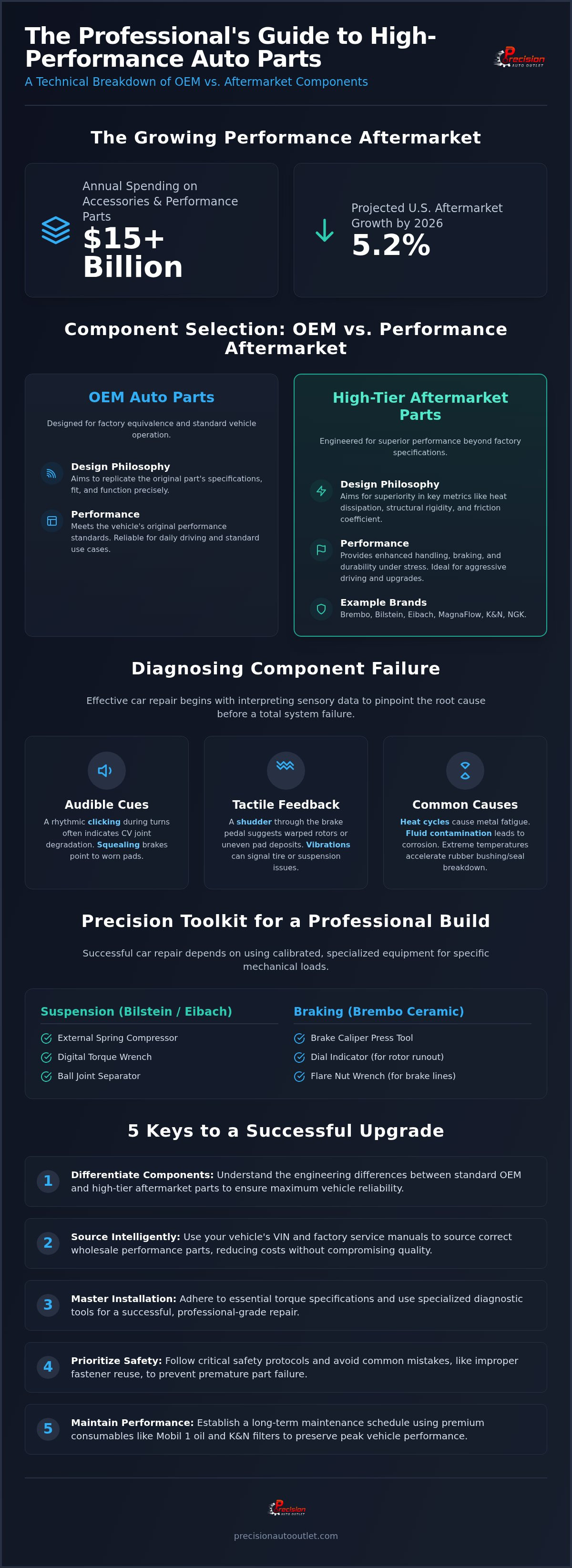
Did you know that pickup truck accessories and performance components alone accounted for over $15 billion in spending last year? As the U.S. light-duty aftermarket is projected to grow by 5.2% in 2026, sourcing reliable wholesale performance parts that professionals nationwide trust has become a technical necessity for any serious build. At Precision Auto Outlet, we understand that a high-performance vehicle is only as strong as its weakest link. Choosing between OEM auto parts and aftermarket auto parts requires more than a surface-level comparison. It requires a commitment to engineering vehicle reliability through precise data and proven components.
I've designed this guide to help you master technical selection, safety protocols, and professional installation of high-tier components. We'll dive into specific torque specs for Bilstein B8 struts, identify failure symptoms, and provide a roadmap for successful car repair. Whether you're focused on routine vehicle maintenance or a complex DIY auto repair, this article provides the granular data needed to ensure your upgrades perform as intended. We'll cover everything from MagnaFlow exhaust systems to NGK spark plugs with surgical precision to help you achieve professional results while maximizing your investment.
Key Takeaways
- Learn to differentiate between OEM and high-tier aftermarket components like Brembo and Bilstein to ensure maximum vehicle reliability.
- Discover how to source wholesale performance parts Dallas to reduce project costs without compromising on technical standards or component quality.
- Master professional installation techniques, including essential torque specifications and the proper use of specialized diagnostic tools for a successful repair.
- Identify critical safety protocols and common installation mistakes, such as improper fastener reuse, to prevent premature part failure.
- Establish a long-term maintenance lifecycle using premium consumables like Mobil 1 synthetic oil and K&N filters to preserve peak vehicle performance.
Wholesale Performance Parts and Diagnostic Fundamentals
The automotive aftermarket industry is structured around a technical hierarchy that separates standard components from high-tier performance upgrades. When sourcing wholesale performance parts Dallas, you must distinguish between basic replacement auto parts and engineered solutions like ACDelco Gold or Brembo Ceramic. Standard parts aim for factory equivalence; performance parts aim for superiority in heat dissipation, friction coefficient, and structural rigidity. Understanding this distinction is the first step in successful DIY auto repair and long-term vehicle maintenance.
Symptoms and Common Causes of Component Failure
Effective diagnostics rely on interpreting sensory data before a total system failure occurs. Audible cues, such as a rhythmic clicking during turns, often signal CV joint degradation. Tactile feedback is equally critical. If you feel a shudder through the brake pedal, it likely indicates warped rotors or uneven pad deposits. For those using Brembo Ceramic pads, these symptoms shouldn't be ignored. They can compromise the entire braking system's thermal capacity. Professional car repair involves looking for specific signs of systemic failure rather than just surface wear.
- Heat Cycles: Frequent high-temperature operations cause metal fatigue in components like exhaust manifolds and brake rotors.
- Fluid Contamination: Moisture in brake fluid or particulates in engine oil can lead to internal corrosion and accelerated wear.
- Friction Wear: This is the literal thinning of material, common in clutch discs and brake linings.
In the Dallas environment, extreme road surface temperatures accelerate the breakdown of rubber bushings and seals. This often leads to fluid leaks in struts or increased play in suspension linkages. These issues require new auto parts to restore factory geometry and safety.
The Quality Benchmark: Selecting Wholesale Performance Components
High-tier brands like Bilstein and Eibach are engineered to tolerances that often exceed original OEM auto parts. For example, Bilstein B8 struts utilize monotube gas pressure technology to provide consistent damping under stress. Selecting these wholesale performance parts Dallas ensures that your vehicle's handling characteristics remain predictable during aggressive maneuvers. Technical specifications, such as those found in ACDelco Gold Oil Filters: Technical Specifications, provide the data necessary to verify that a part meets your specific build requirements. Using precision-fit parts is vital for maintaining alignment and preventing secondary wear on adjacent components.
Pre-Repair Logistics: Required Tools, Parts, and Safety Precautions
Sourcing wholesale performance parts Dallas involves more than just finding the lowest price; it requires a precise technical bill of materials. You must verify part compatibility using your vehicle's 17-digit VIN and a factory service manual. This ensures the components align with factory tolerances and safety requirements. Cross-referencing part numbers against the manufacturer's electronic parts catalog (EPC) prevents the common mistake of ordering for the wrong sub-model or trim level. Professional DIY auto repair starts with a clean, organized staging area where every fastener and component is accounted for before the first wrench is turned.
Technical Tooling and Parts Matrix
Successful car repair depends on using the correct tool for the specific mechanical load. Hand-tightening critical suspension components is a recipe for failure. You need calibrated instruments to meet the engineering requirements of your build.
| Repair Category | Specialized Equipment Required |
|---|---|
| Suspension (Bilstein/Eibach) | External spring compressor, digital torque wrench, ball joint separator |
| Braking (Brembo Ceramic) | Brake caliper press tool, dial indicator for rotor runout, flare nut wrenches |
| Engine Tuning (NGK/K&N) | Spark plug gap tool, feeler gauges, OBD-II diagnostic scanner |
Don't cut corners on consumables. High-performance builds demand Mobil 1 Synthetic Motor Oil 5W-30 to maintain thermal stability under high shear loads. Similarly, NGK Laser Iridium spark plugs provide the precise ignition timing required for forced induction or high-compression engines. For those upgrading intake systems, refer to the K&N Performance Air Filters: Technical Reference to ensure proper filtration and airflow metrics. Using new auto parts without the correct supporting fluids or tools can lead to premature system degradation.
Critical Safety Protocols for Automotive Systems
A professional-grade workspace is non-negotiable. When lifting a vehicle, you must use jack stands rated for the vehicle's curb weight. Never rely on a hydraulic jack alone. Consult your manual for designated jacking points to prevent structural damage or injury. All modifications should respect the Federal Motor Vehicle Safety Standards to ensure the vehicle remains road-legal and safe for occupants. Proper PPE, including nitrile gloves and impact-resistant eye protection, protects against chemical burns and debris.
Disconnect the negative battery terminal before starting electrical or fuel system work. This prevents short circuits and accidental airbag deployment. For fluid changes, use a dedicated containment basin. Dispose of used oil and coolant at a registered Dallas recycling center to comply with environmental regulations. Sourcing high-tier replacement auto parts is the first step, but safe execution is what ensures a successful build.
Technical Execution: Step-by-Step Installation and Torque Specifications
The successful integration of wholesale performance parts Dallas technicians utilize requires a transition from logistical planning to precise mechanical execution. High-performance builds demand more than just a part swap; they require a disciplined approach to assembly to ensure the vehicle remains road-legal and safe. Before beginning, verify that all mounting surfaces are clean and that you have documented the location of every fastener. This technical discipline prevents the secondary wear often associated with hurried DIY auto repair projects. All modifications should respect Federal safety and emissions regulations to maintain vehicle integrity.
Step-by-Step Repair Instructions
Follow these specific steps when installing components like aftermarket auto parts or OEM auto parts to ensure professional results. For a detailed workflow on braking systems, refer to the Brembo Ceramic Brake Pads: Installation Guide.
-
Step 1: Surface Preparation
- What to do: Clean all mounting surfaces with a wire brush and specialized solvent to remove rust and old grease.
- Why it matters: Debris on a hub face or mounting bracket causes runout, which leads to vibrations and uneven wear.
- Common mistakes to avoid: Using a screwdriver to scrape surfaces, which can gouge the metal and create high spots.
- Helpful tip: Use a shop vacuum while brushing to keep dust and metal particulates away from sensitive seals.
-
Step 2: Fastener Documentation
- What to do: Organize removed fasteners in a compartmentalized tray and label their specific locations.
- Why it matters: Modern vehicles use different bolt grades and lengths for a single assembly to manage specific structural loads.
- Common mistakes to avoid: Mixing up bolts, which can lead to bottoming out a fastener and stripping threads in aluminum components.
- Helpful tip: Take high-resolution photos of the assembly before and during teardown for an accurate reassembly reference.
-
Step 3: Component Alignment and Seating
- What to do: Hand-thread all new auto parts for at least three full turns before using any tools.
- Why it matters: This ensures the threads are properly engaged and prevents the catastrophic cost of cross-threading.
- Common mistakes to avoid: Using an impact wrench to start a bolt or nut.
- Helpful tip: If the bolt doesn't turn easily by hand, back it out, check the threads for debris, and re-align the part.
-
Step 4: Final Fastening and Torque
- What to do: Use a calibrated torque wrench to tighten all fasteners to the values specified in the factory service manual.
- Why it matters: Proper clamping force prevents fasteners from backing out under vibration and prevents over-stretching the metal.
- Common mistakes to avoid: Relying on "hand-tight" or "snug" for safety-critical components like brakes or suspension.
- Helpful tip: Mark the head of each bolt with a paint pen once the final torque is achieved to visually confirm the step is complete.
Adhering to Critical Torque Specifications
Torque is the measurement of rotational force, expressed in foot-pounds (ft-lb) or Newton-meters (Nm). In high-performance car repair, hitting these numbers is non-negotiable. Every fastener has a yield point where the metal stretches beyond its elastic limit. If you exceed this point, the bolt loses its ability to hold tension or may snap entirely under load. This is especially critical when installing replacement auto parts on steering or braking systems.
| Fastener Category | General Torque Range (ft-lb) | General Torque Range (Nm) |
|---|---|---|
| Standard M10 Bolt (Grade 8.8) | 35-45 | 47-61 |
| High-Strength M12 Bolt (Grade 10.9) | 70-85 | 95-115 |
| Wheel Lug Nuts (Typical Car/SUV) | 80-100 | 108-135 |
| Brake Caliper Mounting Bolts | 25-40 | 34-54 |
Always verify these ranges against your specific vehicle's factory service manual, as values vary significantly between makes. Proper vehicle maintenance requires calibrated tools; store your torque wrench at its lowest setting to preserve the accuracy of the internal spring. This technical precision ensures that your build remains reliable long after the initial installation.
Post-Installation Refinement: Troubleshooting and Decision Frameworks
Completing the physical assembly of wholesale performance parts Dallas enthusiasts install is only the mid-point of a professional build. System integration testing is required to verify that the new auto parts function within engineered parameters. Start with a static inspection. Check for fluid leaks, harness interference, and fastener security. Once verified, perform controlled, incremental test drives. Listen for harmonic vibrations or erratic sensor data that might indicate a calibration error or mechanical misalignment. Professional vehicle maintenance requires a methodical approach to these final refinements to ensure long-term reliability.
Several common mistakes can compromise a DIY auto repair before the first mile is logged. Ignoring one-time-use fasteners, specifically torque-to-yield (TTY) bolts, is a frequent error. These bolts are designed to stretch and cannot provide the necessary clamping force if reused. Improper lubrication of sliding surfaces on Brembo calipers or failing to purge air from the cooling system after a performance radiator swap will lead to immediate component degradation. Always verify that aftermarket auto parts are compatible with existing factory mounting hardware before final torque is applied.
Troubleshooting Post-Repair Issues
If original symptoms persist after a car repair, you must look beyond the replaced component. Persistent vibrations after installing Bilstein B8 struts might indicate an out-of-balance wheel or a worn control arm bushing rather than a defective strut. New performance brake pads often require a specific bedding-in procedure to transfer a layer of friction material to the rotor. If you experience a "squeal" during the first few stops, it's likely part of this process rather than a failure. For those integrating induction components, consult the Auto Cold Air Intake Systems: Technical Guide to troubleshoot vacuum leaks or mass airflow sensor (MAF) scaling issues.
Repair vs. Replacement Decision Framework
Analyzing the cost-benefit of rebuilding a component versus purchasing new replacement auto parts is vital for vehicle value retention. While rebuilding a specialized performance part might seem cost-effective, internal housing wear often makes such repairs temporary. Modern OEM auto parts are often sold as complete assemblies to ensure every sub-component meets current safety standards. Choosing a new wholesale unit provides a fresh baseline for your maintenance schedule.
| Performance Task | Difficulty Level (1-5) | Estimated Repair Time (Hours) |
|---|---|---|
| Spark Plug Replacement (NGK Laser Iridium) | 2 | 1.0 - 1.5 |
| Brake Pad Swapping (Brembo Ceramic) | 3 | 1.5 - 2.5 |
| Strut/Shock Installation (Bilstein B8) | 4 | 3.0 - 5.0 |
| Exhaust System Bolt-on (MagnaFlow) | 3 | 2.0 - 3.5 |
Success in performance tuning depends on using components that are engineered for the specific stresses of your vehicle. If you're ready to upgrade, browse our catalog of new performance parts to find the exact match for your next project.
Long-Term Maintenance and Performance Lifecycle Management
The lifecycle of wholesale performance parts Dallas technicians install depends heavily on post-installation stewardship. High-performance components are often designed with tighter tolerances than standard OEM auto parts; this means they require more frequent inspections to maintain peak efficiency. Establishing a rigorous vehicle maintenance schedule prevents minor wear from evolving into a catastrophic system failure. Your goal is to preserve the mechanical integrity of the build through consistent monitoring and the use of premium consumables.
Preventative Maintenance for Performance Longevity
Suspension components like Bilstein B8 struts or Eibach springs are exposed to road debris, salt, and extreme temperature fluctuations. To extend their service life, you must regularly clean the mounting surfaces and inspect the protective dust boots for tears. A compromised boot allows grit to enter the seal area; this will cause fluid leaks and loss of damping consistency. For those using high-flow aftermarket auto parts, such as K&N Performance Air Filters, maintenance involves more than just a visual check. These filters require cleaning and re-oiling at specific intervals to maintain their filtration efficiency without restricting airflow.
- Visual Inspection: Check performance belts and hoses for glazing, cracking, or swelling every 5,000 miles.
- Fluid Analysis: Monitor the condition of your Mobil 1 Synthetic Motor Oil 5W-30. Synthetic oils maintain viscosity better under heat, but they still accumulate particulates that can wear down engine bearings.
- Fastener Security: Re-verify the torque on safety-critical fasteners after the first 500 miles of operation to account for initial component settling.
Consistent DIY auto repair requires a proactive approach to wear items. Don't wait for a component to fail before performing an inspection. Checking the integrity of your Bosch wiper blades or the charge level of your Optima battery during every oil change ensures that your vehicle remains road-ready in all conditions.
Technical Summary and Conclusion
Successful car repair is defined by technical precision and the use of high-quality new auto parts. By sourcing through a dependable wholesale performance parts Dallas distributor, you gain access to components that are engineered for reliability. Adhering to the ASE-certified methods outlined in this guide, from proper torque application to disciplined diagnostics, ensures your vehicle performs at its maximum potential. Technical accuracy isn't just about speed; it's about reducing long-term ownership costs by doing the job correctly the first time.
Integrating these professional standards into your workflow transforms a simple part swap into a precision engineered upgrade. Always refer to your vehicle's factory service manual for model-specific procedures and fluid capacities. Maintaining a detailed log of all replacement auto parts and service dates will assist in future troubleshooting and preserve the resale value of your vehicle.
Looking for quality new OEM or aftermarket replacement parts? Precision Auto Outlet offers dependable parts for many makes and models at competitive prices. Browse our catalog to find the right part for your repair.
Engineered Reliability Through Technical Precision
Achieving peak vehicle performance requires a commitment to technical precision. By prioritizing calibrated torque specifications and adhering to strict diagnostic fundamentals; you ensure every component operates within its engineered limits. Sourcing wholesale performance parts Dallas professionals trust provides a foundation of reliability for any DIY auto repair or shop build. Utilizing high-tier components from an authorized ACDelco and Brembo retailer minimizes the risk of premature failure. Precision Auto Outlet supports your mechanical goals with national wholesale distribution and expert technical assistance for complex installations. You now have the framework to execute professional-grade repairs that maintain vehicle safety and long-term value.
Browse Precision Auto Outlet for High-Quality Wholesale Performance Parts to begin your technical upgrade. Your commitment to using the right tools and following factory service manual protocols will result in a more dependable and efficient vehicle.
Looking for quality new OEM or aftermarket replacement parts? Precision Auto Outlet offers dependable parts for many makes and models at competitive prices. Browse our catalog to find the right part for your repair.
Frequently Asked Questions
What is the difference between OEM and wholesale performance parts?
OEM auto parts are original equipment manufactured specifically for your vehicle's factory assembly. Wholesale performance parts often consist of high-tier aftermarket components engineered to exceed factory specifications for heat, friction, and durability. Sourcing wholesale performance parts Dallas distributors provide allows you to access premium brands like Brembo or Bilstein at a lower price point than retail alternatives while maintaining or improving vehicle reliability.
Will using aftermarket performance parts void my vehicle warranty?
Using aftermarket performance parts doesn't automatically void your entire vehicle warranty. Under the Magnuson-Moss Warranty Act, a manufacturer cannot deny warranty coverage unless they can prove the aftermarket part caused the specific failure. It's important to note that the aftermarket part itself isn't covered by the vehicle's factory warranty; it's protected by the part manufacturer's own guarantee.
How do I know if a wholesale performance part is high quality?
High quality is identified by the engineering reputation of the brand and the technical data provided. Look for components from established manufacturers like ACDelco Gold or Eibach that offer specific material certifications and precise fitment data. Quality parts are typically sold through authorized retailers who provide technical support and verify that the items meet or exceed OEM auto parts standards for safety and performance.
Where can I find the torque specifications for my specific make and model?
The most reliable source for torque specifications is your vehicle's factory service manual. You can also find these values in professional repair databases or model-specific technical guides provided by part manufacturers. Using the correct torque is essential for vehicle maintenance, as it ensures fasteners provide the exact clamping force required for structural and mechanical integrity.
Why is it important to use a torque wrench instead of a standard wrench?
A torque wrench is necessary because it provides a measurable way to reach specific engineering tolerances. Standard wrenches rely on "feel," which is often inaccurate and leads to either under-tightening or over-torquing. Over-torquing can stretch a bolt beyond its yield point; this causes the fastener to snap or lose its ability to hold tension during high-performance driving conditions.
How often should I inspect my aftermarket suspension components?
You should perform a visual inspection of your aftermarket suspension every 5,000 to 7,500 miles. During vehicle maintenance, check for leaking seals on Bilstein struts and inspect protective rubber boots for tears. Early detection of debris or fluid loss prevents secondary damage to tires and steering linkages, ensuring the longevity of your performance upgrade.
What are the most common mistakes beginners make in performance DIY repair?
The most frequent errors in DIY auto repair include cross-threading fasteners and reusing one-time-use torque-to-yield bolts. Beginners also frequently fail to clean mounting surfaces, which leads to misalignment and vibration. Following a methodical cleaning protocol and using a digital torque wrench helps prevent these common issues and ensures a successful car repair outcome.
Can I perform a DIY auto repair on a newer vehicle with complex electronics?
You can perform repairs on modern vehicles, but you need an OBD-II diagnostic scanner to interface with the vehicle's computers. Many performance upgrades are mechanical "bolt-on" components, yet they may still influence sensor data. Having the correct technical documentation and diagnostic tools allows you to successfully integrate new auto parts without triggering fault codes or compromising electronic stability systems.
