
This comprehensive guide provides the technical framework necessary to master performance component integration. You'll learn to identify symptoms of factory inefficiency and execute a successful DIY auto repair using professional-grade protocols. We provide the precise torque specifications and safety standards required for installing new auto parts. From diagnostic troubleshooting to long-term maintenance, this resource ensures your replacement auto parts deliver maximum longevity and measurable performance gains during any car repair project.
Key Takeaways
- Identify the technical differences between OEM and high-performance car tuning parts to ensure component compatibility and measurable performance gains.
- Establish a safe workspace by utilizing professional-grade tools and referencing the vehicle's factory service manual for model-specific data.
- Master advanced installation techniques, including the proper clocking of bushings and pre-loading suspension, to prevent premature hardware failure.
- Implement a specialized vehicle maintenance schedule designed for high-stress components to maximize engine efficiency and overall system longevity.
Understanding Performance Tuning: Symptoms and Common Causes for Upgrades
Professional car tuning parts are precision-engineered components designed to optimize vehicle dynamics beyond factory specifications. Standard vehicle maintenance typically involves replacing worn items with equivalent OEM auto parts to restore original function. Performance-oriented DIY auto repair, however, focuses on technical upgrades that enhance efficiency, power delivery, and handling. These aftermarket auto parts address factory limitations where mass-production compromises were made for cost or comfort. This guide covers the technical requirements for integrating high-performance hardware, ranging from intake system optimization to precise suspension geometry adjustments.
Symptoms of Inefficient Factory Tuning
Identifying the need for replacement auto parts starts with recognizing specific mechanical symptoms during operation. Standard equipment often fails to meet the demands of spirited driving or high-load scenarios. Look for these indicators:
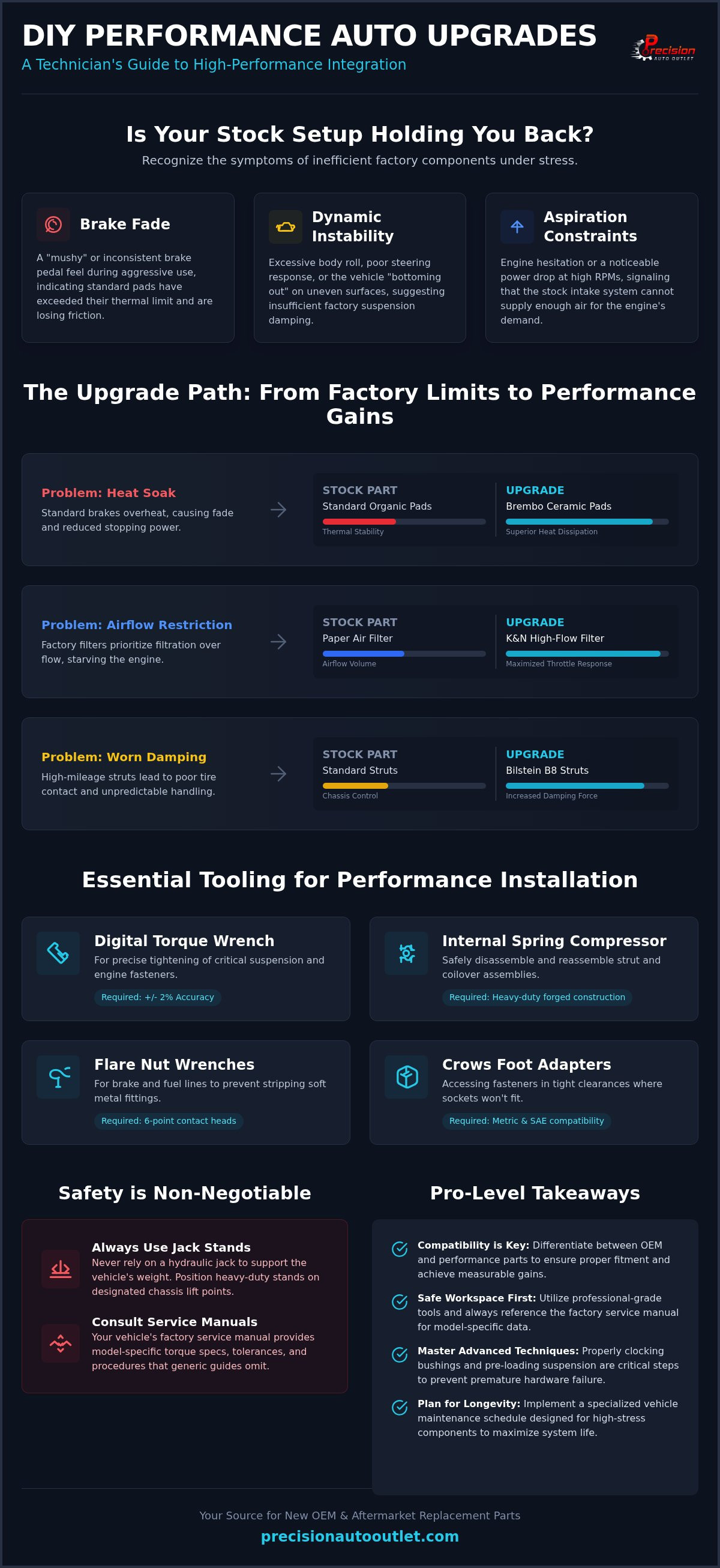
- Brake Fade: A "mushy" or inconsistent brake pedal feel during aggressive use indicates that standard pads have reached their thermal limit.
- Dynamic Instability: Excessive body roll or a vehicle that "bottoms out" on uneven surfaces suggests the factory damping is insufficient for current performance demands.
- Aspiration Constraints: Engine hesitation or a noticeable drop in power at high-RPM ranges often signals air starvation. This occurs when the intake system cannot satisfy the engine's volumetric efficiency requirements.
Common Causes for Performance Component Integration
Standard components often fail under high-stress conditions due to heat and mechanical restriction. Standard braking systems are susceptible to heat soak, where heat builds up faster than it can dissipate. Integrating Brembo Ceramic Brake Pads provides superior thermal stability and consistent friction levels. This is a critical step in any performance car repair project.
Similarly, factory air filters are designed for long service intervals but often restrict airflow to protect the engine from every possible contaminant. K&N Performance Air Filters utilize high-flow media to reduce pressure drop across the intake, allowing for better throttle response. Finally, high-mileage wear degrades standard struts, leading to poor tire contact and unpredictable handling. Upgrading to Bilstein B8 Performance Plus Struts restores chassis control by providing increased damping force specifically tuned for performance-oriented spring rates.
Preparation Protocols: Required Tools, Parts, and Safety Standards
Execution of a successful performance upgrade depends on the quality of your workspace and the precision of your hardware. Professional car tuning parts installation requires a controlled environment where technical data is readily accessible. You must consult your vehicle's factory service manual before beginning any procedure. This document provides the specific tolerances and clearance requirements that generic guides omit. Establishing a methodical staging area ensures that every component is accounted for before the vehicle is rendered inoperable.
When selecting hardware, prioritizing new auto parts over refurbished alternatives is a fundamental safety requirement. High-performance applications subject components to extreme thermal and mechanical loads. Refurbished parts often lack the structural integrity needed to withstand these stresses. You should categorize your inventory into primary components, such as high-performance struts, and secondary hardware, including one-time-use TTY (Torque-to-Yield) bolts. Using dependable aftermarket auto parts ensures that each system integrates seamlessly with existing OEM auto parts.
Essential Tooling for Performance Installation
Precision tuning requires specialized equipment beyond a standard socket set. Digital torque wrenches are the preferred choice for high-performance suspension and engine work. These tools offer higher accuracy and often include angle measurement capabilities required for modern TTY fasteners. Accessing exhaust and intake manifolds frequently requires swivel-head ratchets and long-reach extensions to navigate tight engine bays.
| Tool Name | Application | Technical Requirement |
|---|---|---|
| Digital Torque Wrench | Critical Fasteners | +/- 2% Accuracy Rating |
| Internal Spring Compressor | Strut Assemblies | Heavy-duty forged construction |
| Flare Nut Wrenches | Brake and Fuel Lines | 6-point contact to prevent stripping |
| Crows Foot Adapters | Tight Clearances | Metric and SAE compatibility |
Safety Precautions for High-Performance Work
Safety is the primary concern during any DIY auto repair. Never rely on a hydraulic floor jack to support the vehicle's weight while you are underneath it. Always utilize heavy-duty jack stands rated for your vehicle's specific curb weight. Position the stands on designated chassis lift points to prevent structural damage or slipping.
Personal Protective Equipment (PPE) is mandatory. Eye protection prevents debris and pressurized fluids from causing injury. Chemical-resistant gloves protect against caustic fluids like brake fluid and synthetic oils. When working with high-pressure fuel systems or cooling loops, you must depressurize the system according to the factory service manual. Failure to do so can result in the sudden release of flammable or scalding liquids, posing a severe risk to the technician.
Technical Installation Procedures and Torque Specifications
Executing a performance upgrade requires a systematic approach to ensure that high-stress car tuning parts function as intended. Precision during the installation phase prevents mechanical interference and ensures that your replacement auto parts maintain their structural integrity under load. The following table provides a technical overview of the resources required for common performance modifications.
| Modification Type | Estimated Repair Time | Difficulty Level | DIY Cost Est. | Professional Cost Est. |
|---|---|---|---|---|
| Cold Air Intake System | 1–2 Hours | Beginner | $300 – $500 | $500 – $750 |
| Performance Cat-Back Exhaust | 2–4 Hours | Moderate | $800 – $1,200 | $1,100 – $1,600 |
| Struts and Lowering Springs | 4–6 Hours | Advanced | $1,200 – $1,800 | $1,800 – $2,600 |
Step-by-Step Repair Instructions
Following a standardized DIY auto repair sequence is vital for system safety. Always refer to your vehicle's factory service manual for model-specific bolt patterns and clearance data.
-
Step 1: Secure the Vehicle and Access Components
- What to do: Lift the vehicle using a heavy-duty floor jack and secure it on jack stands at the designated chassis points.
- Why it matters: Proper stabilization prevents vehicle shifts during high-torque applications.
- Common mistakes to avoid: Never work under a vehicle supported only by a hydraulic jack.
- Helpful tips: Use wheel chocks on the opposite end of the vehicle for secondary security.
-
Step 2: Remove Restrictive Factory Hardware
- What to do: Disconnect the negative battery terminal and remove the OEM auto parts being replaced, such as the air box or factory struts.
- Why it matters: Removing standard components provides the necessary clearance for performance-oriented hardware.
- Common mistakes to avoid: Forcing seized bolts can shear the head; use penetrating oil on exhaust and suspension fasteners 24 hours in advance.
- Helpful tips: Label all disconnected sensors and vacuum lines to ensure correct reassembly.
-
Step 3: Install Performance Components
- What to do: Seat the new hardware, such as Bilstein B8 Performance Plus Struts, into the mounting brackets.
- Why it matters: Correct alignment ensures the component operates within its intended range of motion.
- Common mistakes to avoid: Tightening suspension bolts while the vehicle is in the air can tear bushings.
- Helpful tips: Apply a small amount of anti-seize to non-critical threads to facilitate future vehicle maintenance.
-
Step 4: Execute Final Torque and Pre-load
- What to do: Lower the vehicle to its natural ride height and use a digital torque wrench to tighten all fasteners to the values listed below.
- Why it matters: Pre-loading the suspension prevents bushing bind and ensures the aftermarket auto parts settle correctly.
- Common mistakes to avoid: Guessing torque values often leads to stripped threads or loose components.
- Helpful tips: Mark torqued bolts with a paint pen to provide a visual reference for future inspections.
Critical Torque Specifications
Adhering to precise tension requirements is mandatory for high-performance builds. The following values are industry standards for common car tuning parts, but you must verify them against your specific factory service manual.
| Fastener Location | Torque Specification (lb-ft) | Technical Requirement |
|---|---|---|
| Upper Strut Mount Nuts | 35 – 55 | Do not use impact tools |
| Lower Strut Clevis Bolts | 110 – 140 | Verify if TTY (Torque-to-Yield) |
| Brake Caliper Bracket Bolts | 75 – 110 | Clean threads before assembly |
| Exhaust Flange Nuts | 25 – 35 | Tighten in an alternating sequence |
| Intake Manifold Bolts | 15 – 20 | Follow center-outward pattern |
Troubleshooting and Component Analysis: Common Mistakes to Avoid
Diagnostic precision is the final stage of any high-performance car tuning parts installation. Post-installation Noise, Vibration, and Harshness (NVH) often indicate specific assembly errors rather than component failure. You must distinguish between the mechanical characteristics of high-performance hardware and actual installation defects. Successful troubleshooting requires a methodical return to the vehicle's factory service manual to verify that every fastener and sensor is calibrated to its secondary, performance-oriented specification.
Determining the "When to Replace Instead of Repair" threshold is critical for high-stress components. Performance parts operate under extreme thermal and mechanical loads. If a component shows signs of heat-induced discoloration, structural hairline fractures, or excessive play in spherical bearings, it's safer to install new aftermarket auto parts. Precision Auto Outlet provides the technical-grade replacement auto parts needed to correct installation failures and maintain system integrity.
Identifying and Correcting Common Installation Errors
Installation errors often manifest as immediate drivability issues. Addressing these proactively prevents long-term damage to the engine and chassis. Common technical failures include:
- Vacuum Leaks: Rough idling or lean codes after installing a cold air intake usually stem from unmetered air. Check the silicon couplers and clamps between the intake tube and throttle body for airtight seals.
- Improper Spring Seating: A "popping" sound during low-speed maneuvers indicates that lowering springs aren't clocked correctly in the lower perches. The coil end must sit flush against the perch stop.
- Fastener Over-Torquing: Using an impact wrench on performance alloy fasteners often leads to thread stretching or snapping. Always use a calibrated digital torque wrench for final assembly to ensure the fastener remains within its elastic limit.
Troubleshooting Performance Issues Post-Installation
Modifying airflow or suspension geometry fundamentally changes how the vehicle's computer and chassis interact. If you've installed high-flow intake or exhaust components, monitor the Air-Fuel Ratio (AFR). Significant modifications can push the ECU beyond its ability to compensate, resulting in a lean condition that risks piston damage. Datalogging is the most efficient way to verify that your car tuning parts are operating within safe stoichiometric limits.
Brake noise is another common area of confusion. High-performance pads, like Brembo Ceramic Brake Pads, often produce more noise than standard OEM auto parts during the initial bed-in phase. However, a persistent grinding sound indicates a loose caliper bracket or a backing plate contacting the rotor. Finally, any change to ride height alters the vehicle's toe, camber, and caster. A professional four-wheel alignment is mandatory after any suspension work to prevent rapid tire wear and ensure predictable handling at high speeds.
Long-Term Maintenance and System Longevity
Performance tuning significantly increases the thermal and mechanical stress on your vehicle's core systems. Standard vehicle maintenance schedules provided by the manufacturer are designed for stock configurations and conservative driving. Once you've integrated high-performance car tuning parts, you must adopt a more frequent inspection cycle. This proactive approach preserves the efficiency of your upgrades and prevents the premature failure of adjacent OEM auto parts.
Monitoring wear patterns is essential for maintaining safety. High-performance brake rotors and ceramic pads operate at higher friction levels, which can accelerate wear on standard replacement auto parts. You should inspect these components during every tire rotation. Look for heat-induced discoloration or uneven pad wear, which often signals a need for caliper servicing or system re-bedding.
Maintenance Protocols for Tuned Vehicles
High-flow intake systems require specific care to maintain volumetric efficiency. While standard paper filters are discarded, performance filters are cleaned and re-oiled. Inspect your filter every 25,000 miles in performance applications. If the pleats are no longer visible through the captured debris, perform a full cleaning cycle. You must avoid over-oiling the media, as excess oil can contaminate the Mass Air Flow (MAF) sensor and trigger lean-run conditions.
Lubrication requirements also change with increased power output. Tuned engines often operate at higher internal temperatures, which can break down motor oil faster than standard configurations. Utilizing high-efficiency filtration is mandatory to protect internal engine bearings. ACDelco Gold Oil Filters provide the structural integrity and filtration media density required to handle increased flow rates and oil pressures. Pair these with high-quality synthetic lubricants to ensure maximum engine longevity.
Suspension components also demand regular physical inspections. Check strut shafts for signs of hydraulic fluid weeping and inspect lowering springs for any coating damage that could lead to corrosion. Inspecting suspension bushings for "clocking" or tearing is vital, especially if the vehicle is driven on uneven surfaces. If you detect any rubber degradation, it's time to perform a car repair using high-durometer aftermarket auto parts.
Conclusion: The Path to Successful Performance Tuning
Technical precision is the foundation of a successful vehicle build. Selecting high-quality car tuning parts is only the first step. The longevity of your vehicle depends on your adherence to torque specifications, safety protocols, and a rigorous maintenance schedule. By treating DIY auto repair as a methodical engineering process, you ensure that your vehicle delivers consistent power and reliable handling for years to come.
Before your first post-installation test drive, complete this final safety checklist:
- Verify all critical fasteners are torqued to the factory service manual specifications.
- Confirm all fluid levels, including coolant and brake fluid, are at the maximum fill line.
- Inspect all new auto parts for clearance against moving chassis components.
- Perform a static leak test by running the engine and checking for fluid or air escapes.
Looking for quality new OEM or aftermarket replacement parts? Precision Auto Outlet offers dependable parts for many makes and models at competitive prices. Browse our catalog to find the right part for your repair.
Optimizing Your Build for Long-Term Performance
Successful vehicle optimization depends on the integration of high-quality car tuning parts and strict adherence to technical installation standards. You've learned that precision torque specifications and proper component bedding are essential for both safety and efficiency. Maintaining a rigorous inspection schedule ensures that your high-performance hardware continues to operate within its design parameters. These technical protocols prevent premature wear and maintain the balance between power and reliability.
Precision Auto Outlet supports DIY mechanics with expert technical guidance and national delivery for industry-leading performance brands. Our extensive inventory includes specialized components from Bilstein, Brembo, and K&N to ensure your build meets professional standards. We provide the reliable hardware needed for successful engine and chassis modifications. Browse our catalog to find the right car tuning parts for your repair. With the right tools and a methodical approach, you'll achieve professional results in your own garage.
Frequently Asked Questions
What is the difference between OEM and aftermarket car tuning parts?
OEM auto parts are manufactured to the original factory specifications, prioritizing mass-market comfort and cost-efficiency. Aftermarket car tuning parts are precision-engineered to exceed these factory limitations, offering enhanced material strength and optimized performance characteristics. These components allow for adjustments in power delivery and chassis dynamics that standard parts cannot provide.
Will installing performance tuning parts void my vehicle's warranty?
The Magnuson-Moss Warranty Act protects consumers in the United States. A dealership cannot legally void your entire vehicle warranty simply because you installed aftermarket auto parts. To deny a warranty claim, the manufacturer must prove that the specific modified part directly caused the failure of the component in question.
How do I know if my car needs a 1-way or 2-way adjustable strut?
1-way adjustable struts utilize a single knob to adjust rebound and compression damping simultaneously. These are suitable for most street applications and occasional track use. 2-way adjustable struts allow for independent tuning of rebound and compression, providing the granular control required for dedicated competitive driving and specific track conditions.
Can I install performance brake pads on stock rotors?
You can install performance brake pads on stock rotors if the rotors meet the minimum thickness requirements specified in your factory service manual. The rotors must be free of warping or significant scoring. Some aggressive track pads may accelerate the wear rate of standard iron rotors compared to high-performance slotted or drilled alternatives.
How much horsepower can I expect from a cold air intake and exhaust?
Horsepower gains depend on the vehicle's engine type and original intake restrictions. Naturally aspirated engines typically see a 3% to 5% increase in peak power. Turbocharged vehicles often achieve higher gains, sometimes exceeding 10%, as the reduced backpressure allows the turbocharger to spool more efficiently and maintain higher boost levels.
What happens if I don't use a torque wrench on suspension components?
Failing to use a torque wrench leads to inconsistent clamping force. Under-tightened fasteners can vibrate loose, causing catastrophic mechanical failure. Over-tightened bolts may exceed their elastic limit and snap. In suspension systems, incorrect torque settings also prevent proper bushing pre-load, which results in unpredictable handling and premature hardware wear.
How often should I clean a performance air filter compared to a standard one?
Standard air filters are disposable and require replacement every 12,000 to 15,000 miles. Performance filters, such as K&N Performance Air Filters, are reusable. You should inspect them every 25,000 miles and perform a cleaning and re-oiling service only when the filter pleats are no longer visible through the accumulated debris.
Are ceramic brake pads better for daily driving or track use?
Ceramic brake pads are superior for daily driving due to their low noise, minimal dust production, and excellent cold-stopping power. They maintain consistent friction levels during normal operating temperatures. For heavy track use, semi-metallic pads are often preferred because they possess a higher thermal threshold and resist brake fade better under extreme heat.

