
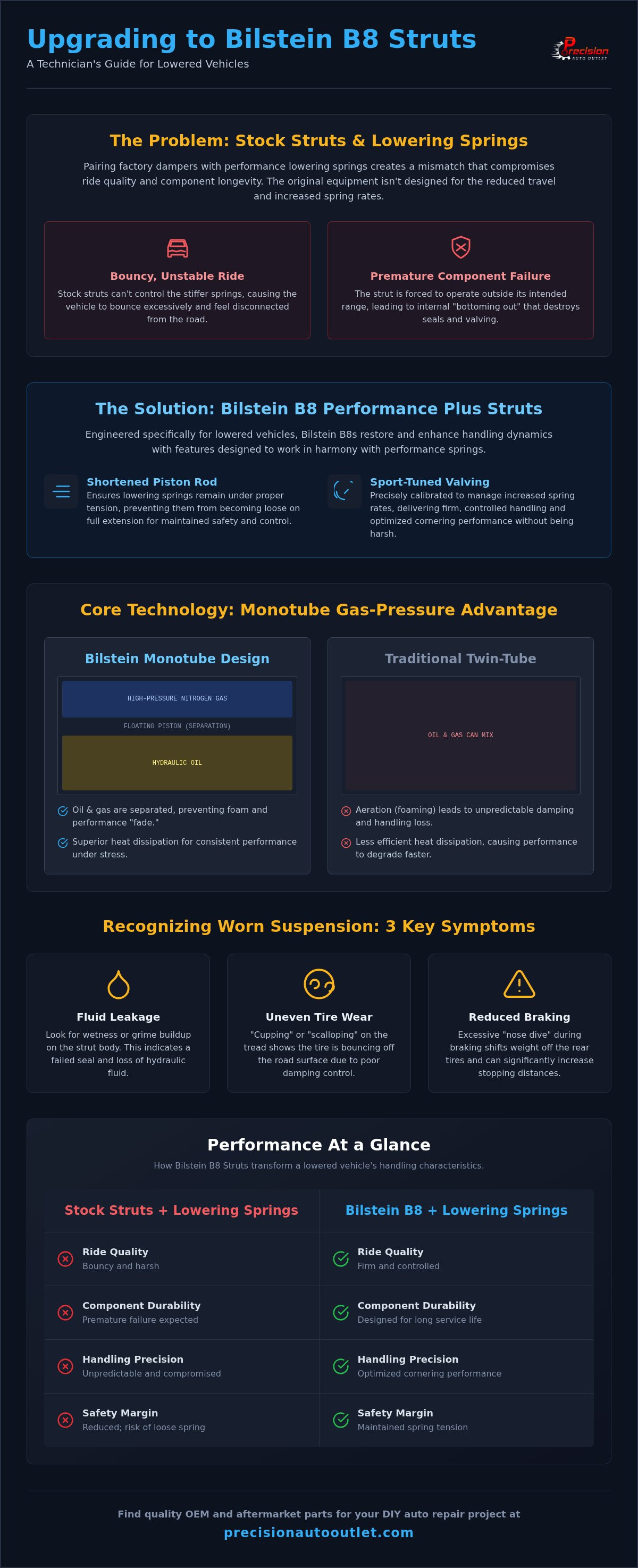
Your factory struts weren't designed to handle the increased spring rates and reduced travel of a lowered vehicle. Many enthusiasts find that pairing lowering springs with stock dampers leads to a bouncy ride and premature component failure. You've likely noticed that the aggressive look of your car doesn't match the actual road feel. Bilstein B8 Performance Plus Struts solve this by providing a shortened piston rod and sport-tuned valving specifically for performance springs. We agree that a lowered car should handle better, not worse, than it did on the showroom floor. Relying on original equipment dampers for aftermarket height drops is a recipe for a compromised driving experience.
This guide provides the technical specifications and step-by-step instructions needed to achieve professional-grade handling in your own garage. You'll master the nuances of monotube high-pressure gas technology and learn how to maintain correct suspension geometry during the swap. We'll cover everything from the required tool list to precise torque specifications for 2026 applications. By the end of this article, you'll have the expertise to complete a successful DIY installation that ensures long-term durability and optimized cornering performance. We've organized this data to facilitate quick decision-making and efficient information retrieval for your next car repair project.
Key Takeaways
- Understand why Bilstein B8 Performance Plus Struts are engineered with a shortened stroke to optimize handling on vehicles with aftermarket lowering springs.
- Identify the specialized tools and safety protocols required to perform a professional-grade DIY auto repair on your suspension system.
- Learn the step-by-step installation process, including why adhering to specific torque values is critical for maintaining correct vehicle geometry.
- Discover how to troubleshoot common post-installation issues like clunking sounds or rapid tire wear through proper alignment and inspection.
- Gain insights into long-term maintenance standards and lifecycle management to maximize the durability of your new performance dampers.
Technical Overview and Diagnostic Indicators for Bilstein B8 Struts
Bilstein B8 Performance Plus Struts are high-performance dampers engineered specifically for vehicles with reduced ride height. Unlike standard dampers, B8s feature a shortened piston rod. This design ensures that the lowering spring remains under proper tension even when the suspension is fully extended. If you use a standard-length strut with a lowering spring, the spring can become loose during rebound. This movement compromises safety and ruins the predictable handling enthusiasts expect. These struts aren't just replacements; they're precision tools designed to work in harmony with a lowered center of gravity. Pairing them with high-quality aftermarket auto parts like Eibach Sportline lowering springs ensures the suspension geometry remains within optimal parameters.
The core of this component is Bilstein's monotube gas-pressure technology. In a traditional shock absorber, oil and gas can mix, which leads to "fade" during aggressive driving. Bilstein's design separates the oil and nitrogen gas with a floating piston. This architecture allows for a larger working piston, providing more precise damping force and superior heat dissipation. It's a critical feature for drivers who demand consistent performance during high-speed cornering. By keeping the oil under pressure, the system prevents cavitation and ensures the valving reacts instantly to road inputs.
Recognizing Symptoms of Suspension Degradation
Worn suspension components directly impact vehicle safety and tire longevity. You'll notice excessive body roll during sudden maneuvers or high-speed turns if the dampers are failing. If the car feels like it's "floating" or continues to bounce after hitting road irregularities, the internal valving is likely compromised. These symptoms indicate the strut can no longer control the spring's stored energy effectively. When Bilstein B8 Performance Plus Struts eventually wear down, these handling deficits become increasingly apparent.
- Visible hydraulic fluid leakage: Look for wetness or grime buildup on the strut body or around the upper seals.
- Uneven tire wear: Check for "cupping" or "scalloping" on the tread surface. This happens when the tire bounces off the road due to poor damping.
- Reduced braking efficiency: Failing struts cause excessive nose dive, which shifts weight off the front tires and increases stopping distances.
Common Causes of Performance Strut Failure
The most frequent cause of premature failure is pairing standard-length struts with lowering springs. This configuration forces the strut to operate at the bottom of its stroke, leading to internal bottoming out. This metal-on-metal contact quickly destroys internal seals and valving. Environmental factors also contribute to degradation. Road salt and debris can score the chrome piston rod, which eventually tears the oil seals as the rod moves through the housing.
High-cycle fatigue is another factor for performance enthusiasts. Aggressive driving or frequent track usage subjects the dampers to extreme thermal loads. While the monotube design handles heat better than twin-tube alternatives, years of high-stress cycles will eventually wear down the internal components. Regular inspections are necessary to identify these issues before they lead to a complete suspension failure during a critical maneuver. Using correct replacement auto parts for your vehicle's specific ride height avoids these common failure points.
Preparation Protocol: Required Tools, Parts, and Safety Standards
Successful DIY auto repair begins long before you break a bolt loose. Logistical preparation is the difference between a one-day project and a vehicle stranded on jack stands for a week. You must consult your vehicle's factory service manual for model-specific procedures and fastener locations. This document provides the exact sequences required to maintain the structural integrity of your chassis. Organizing a clean, well-lit workspace prevents component contamination and ensures that small hardware isn't lost during the disassembly phase.
Adopt a "while-you-are-in-there" replacement strategy to maximize your labor efficiency. When installing Bilstein B8 Performance Plus Struts, inspect your strut mounts, bearings, and spring isolators for signs of dry rot or compression set. Replacing these inexpensive rubber components now prevents future noise issues and saves you from repeating the entire labor process. If your vehicle has high mileage, consider sourcing high-quality replacement auto parts like new mounting hardware to ensure a professional-grade result.
Required Tools and Replacement Parts Inventory
Acquire all necessary equipment before starting the teardown. Suspension work requires more than a basic socket set. You'll need a floor jack with a high lift capacity and a pair of jack stands rated for your vehicle's weight. A calibrated torque wrench is non-negotiable for securing critical fasteners. For the struts themselves, ensure you have the Bilstein B8 units and any required external bump stops if they aren't internally integrated into the damper design.
| Tool Category | Essential Items |
|---|---|
| Standard Tools | Floor jack, jack stands, metric/SAE socket set, breaker bar, penetrating oil. |
| Specialized Equipment | Spring compressor, pass-through strut nut socket, calibrated torque wrench, impact wrench. |
Critical Safety Precautions for Suspension Work
Safety is the primary priority when dealing with compressed springs and heavy vehicle components. Never work under a car supported only by a hydraulic jack; always utilize rated jack stands on a level, concrete surface. Stored energy in a coil spring can be lethal if released unexpectedly. Use a high-quality spring compressor and ensure the hooks are fully seated before applying tension. Wear impact-rated eye protection and heavy-duty gloves to protect against debris and pressurized fluids. All modifications must align with federal safety standards for suspension systems to ensure the vehicle remains roadworthy after the repair. Check your compressor for signs of thread wear or cracks before each use.
Step-by-Step Installation Procedure and Torque Specifications
Executing a successful suspension upgrade requires a systematic approach to preserve the vehicle's handling characteristics. When you install Bilstein B8 Performance Plus Struts, you're modifying the dampening rate and stroke length of your suspension to match a lowered ride height. Since the wheels must be removed for this process, it's an ideal time to inspect other critical components. If you notice thin friction material or rotor scoring, consider installing Brembo Ceramic Brake Pads to complement your improved cornering capabilities. This section outlines the mechanical sequence for a standard strut-style suspension.
Detailed Repair Instructions
-
1. Vehicle Preparation and Wheel Removal
What to do: Loosen lug nuts, lift the vehicle, and place it on rated jack stands before removing wheels.
Why it matters: Provides necessary access to the wheel well and chassis mounting points.
Common mistake: Positioning the floor jack on plastic rocker panels or thin floor pans.
Helpful tip: Use a breaker bar to loosen lug nuts while the tires are still in contact with the ground to prevent the wheel from spinning. -
2. Component Disconnection
What to do: Detach sway bar end links and brake line brackets from the strut body.
Why it matters: Allows the strut assembly to move independently and prevents damage to hydraulic lines.
Common mistake: Letting the brake caliper hang by the rubber hose, which causes internal line failure.
Helpful tip: Apply penetrating oil to the end link threads 15 minutes before removal to ease stubborn fasteners. -
3. Lower Strut and Knuckle Separation
What to do: Remove the lower pinch or clevis bolts while supporting the hub assembly.
Why it matters: Separates the damper from the steering knuckle and prevents the hub from dropping.
Common mistake: Allowing the knuckle to fall outward, which can pull the inner CV joint apart.
Helpful tip: Use a bungee cord or heavy wire to secure the knuckle to the frame once the strut is free. -
4. Spring Transfer to Bilstein B8
What to do: Use a spring compressor to remove the spring from the old unit and install it onto the new B8 strut.
Why it matters: The B8 features a shortened stroke specifically engineered for performance lowering springs.
Common mistake: Using an impact wrench on the top piston rod nut, which spins the rod and ruins the internal valving.
Helpful tip: Ensure the ends of the spring coils are seated perfectly against the stops in the rubber isolators. -
5. Final Reassembly and Pre-loading
What to do: Reinstall the assembly and tighten fasteners only after compressing the suspension with a jack.
Why it matters: Prevents rubber bushings from being locked in a twisted position, which leads to premature tearing.
Common mistake: Performing the final torque sequence while the wheels are hanging at full droop.
Helpful tip: Use a floor jack under the lower control arm to lift the suspension to its normal ride height before tightening bolts.
Torque Specifications and Project Metrics
Adhering to precise torque values ensures your car repair meets Federal Motor Vehicle Safety Standards for structural integrity. Over-tightening can stretch bolts, while under-tightening leads to dangerous component play. Always verify these ranges in your factory service manual, as they vary by chassis type. Typical upper mount bolts require 20 to 40 ft-lbs, while larger lower clevis bolts often demand 50 to 80 ft-lbs.
| Metric | Specification |
|---|---|
| Estimated Repair Time | 3 to 5 Hours |
| Difficulty Level | Advanced DIY / Professional |
| Specialty Tools Required | Spring Compressor, Torque Wrench |
| Expense Category | DIY Auto Repair | Professional Installation |
|---|---|---|
| Parts Cost | Standard Retail | Retail + Shop Markup |
| Labor Charges | $0.00 | $400.00 – $600.00 |
| Total Investment | Lower Overall Cost | Higher (Includes Warranty on Labor) |
Troubleshooting and Professional Installation Error Mitigation
Post-installation monitoring is essential for verifying the success of your car repair. After fitting Bilstein B8 Performance Plus Struts, expect a "break-in" period of approximately 500 miles. During this initial phase, the internal seals and new mounting hardware settle into their final operating positions. You might notice subtle changes in ride height as the springs seat fully into the isolators. Maintaining this level of mechanical awareness is just as important as routine windshield wiper maintenance for the overall longevity and safety of your vehicle.
Immediate professional alignment is mandatory. Even a minor deviation in strut positioning alters your vehicle's toe, camber, and caster settings. Failing to perform a four-wheel alignment within the first 100 miles leads to rapid tire degradation. This damage is often characterized by aggressive "feathering" or "saw-tooth" wear patterns on the tread edges. If you encounter damaged hardware or worn bushings during your post-install inspection, you can find high-quality aftermarket auto parts to restore your vehicle's performance. Promptly addressing these issues prevents a cascade of failures across the steering rack and control arm bushings.
Common Mistakes to Avoid During DIY Repair
Technical errors during assembly often lead to premature component failure and voided warranties. One frequent mistake is using an impact wrench on the top piston rod nut. The high-frequency vibrations and rotational force can spin the internal rod, destroying the delicate valving of the Bilstein B8 Performance Plus Struts. Always use a pass-through socket and a manual torque wrench to secure this fastener. Additionally, many technicians fail to mark the orientation of the upper mount before removal. Incorrect indexing results in misaligned caster angles that cannot be corrected by simple toe adjustments. Finally, never reuse Torque-to-Yield (TTY) fasteners. These bolts are designed to stretch once to achieve their clamping force; reusing them risks structural failure under high cornering loads.
Troubleshooting Tips for Post-Installation Issues
Identifying specific noises helps isolate installation errors without a full teardown. A rhythmic metallic knocking or "clunking" over small bumps usually points to loose sway bar end links. These fasteners must be tightened while the suspension is under load to prevent binding. If you hear a grinding or "boing" sound during low-speed turns, the coil spring is likely not properly indexed in the strut perch. The end of the coil must sit flush against the molded stop in the rubber isolator to prevent spring rotation. Lastly, verify the strut housing is fully seated in the steering knuckle. If the strut is not bottomed out against the knuckle's internal stop, the vehicle's ride height will be uneven and the pinch bolt won't provide adequate clamping force. Check your brake line brackets for any signs of rubbing against the wheel well, which indicates an incorrect mounting angle.
Long-Term Lifecycle Management and Replacement Standards
Maintaining high-performance suspension requires a proactive inspection protocol to preserve handling precision. While Bilstein claims their products can last approximately four times as long as original equipment, real-world longevity depends on your specific driving environment. Establish a recurring inspection schedule every 12,000 miles or during your annual vehicle maintenance routine. This cadence allows you to identify minor seal weeping or bushing degradation before it compromises the safety of your chassis. High-performance dampers like Bilstein B8 Performance Plus Struts operate under higher internal pressures than standard units, making regular oversight essential for professional-grade results.
Environmental factors significantly influence the lifecycle of your aftermarket auto parts. Road salt, magnesium chloride, and abrasive grit can score the chrome-plated piston rod. These imperfections eventually tear the internal oil seals as the rod cycles through the housing. To protect the finish and internal components, clean the strut bodies during every oil change. Removing accumulated debris prevents the "sandpaper effect" on the seals. If you operate your vehicle in a coastal or rust-belt region, consider applying a specialized hydrophobic coating to the strut housing to mitigate surface corrosion and preserve the structural integrity of the mounting points.
Deciding between repair and replacement is straightforward for the B8 series. These dampers are engineered as sealed, high-pressure units. If you observe significant hydraulic fluid pooling, a total loss of damping resistance, or a bent piston rod from impact, a full replacement is the only safe solution. Attempting to "rebuild" a non-serviceable street strut is dangerous and violates OEM auto parts safety standards. Always replace struts in axle pairs to ensure balanced damping rates across the vehicle. This practice maintains predictable handling and prevents the vehicle from pulling or diving unevenly during high-speed maneuvers.
Maintenance Tips for High-Performance Struts
- Seal Protection: Wipe down the exposed piston rods with a clean, lint-free cloth during every DIY auto repair session to remove grit.
- Component Inspection: Check the rubber dust boots and bump stops for cracking or dry rot annually. Replace these replacement auto parts immediately if they are compromised to prevent debris from entering the main seal.
- System Synergy: Monitor your engine health by using ACDelco Gold Oil Filters. A well-maintained engine reduces vibration and heat soak, which indirectly benefits the longevity of under-hood suspension mounting hardware.
- Fastener Check: Re-verify the torque on your upper mount bolts and sway bar end links 500 miles after the initial car repair to account for component settling.
Conclusion: The Precision Approach to Suspension
Choosing Bilstein B8 Performance Plus Struts represents a commitment to technical excellence and optimized vehicle control. By utilizing a monotube design and a shortened stroke, these dampers provide the necessary tension for lowering springs that standard struts cannot match. This guide has detailed the technical specifications, safety protocols, and installation steps required to master your suspension geometry. Adhering to these professional standards ensures your vehicle remains a "model athlete" on the road. Before finishing your project, complete this final checklist:
- Confirm a professional four-wheel alignment has been performed to factory or performance specifications.
- Verify all fasteners meet the specific foot-pound requirements found in your factory service manual.
- Perform a visual inspection for any interference between the strut body and brake lines or ABS sensors.
- Conduct a low-speed test drive to listen for any abnormal mechanical noise or binding.
Looking for quality new OEM or aftermarket replacement parts? Precision Auto Outlet offers dependable parts for many makes and models at competitive prices. Browse our catalog to find the right part for your repair.
Achieving Professional-Grade Suspension Performance
Upgrading to Bilstein B8 Performance Plus Struts transforms a lowered vehicle's handling from compromised to professional-grade. You've mastered the mechanical necessity of shortened piston rods and the critical nature of precise torque application during installation. Adhering to the break-in protocol and maintaining an annual inspection schedule ensures your investment delivers peak damping performance for years. Success in this car repair project relies on technical accuracy and high-quality components. Precision Auto Outlet provides expert-reviewed technical guides and competitive pricing on performance suspension solutions. We offer national shipping on all aftermarket auto parts to streamline your next project.
Looking for quality new OEM or aftermarket replacement parts? Precision Auto Outlet offers dependable parts for many makes and models at competitive prices. Browse our catalog for Bilstein B8 Performance Plus Struts to find the right part for your repair. Your commitment to technical precision ensures a safer, more responsive driving experience. You're now ready to restore your vehicle's handling and enjoy the road with confidence.
Frequently Asked Questions
Can I use Bilstein B8 struts with my factory (OEM) springs?
You shouldn't use Bilstein B8 Performance Plus Struts with factory springs. These dampers feature a shortened piston rod designed specifically for reduced ride heights. Pairing them with tall OEM springs can cause the damper to operate outside its intended stroke range; this potentially leads to internal damage or improper spring seating during rebound.
What is the difference between Bilstein B6 and B8 struts?
The primary difference is the intended ride height of the vehicle. Bilstein B6 struts are designed for vehicles at factory ride height using original equipment springs. Bilstein B8 struts are functionally similar in valving but feature a shorter stroke length to accommodate aftermarket lowering springs without bottoming out.
Do I need to get an alignment immediately after installing B8 struts?
A professional four-wheel alignment is mandatory immediately after any suspension car repair. Removing the strut assembly disrupts the relationship between the steering knuckle and the chassis. Even a slight deviation in toe or camber settings will cause rapid tire degradation and unpredictable handling during high-speed maneuvers.
How long do Bilstein B8 Performance Plus struts typically last?
Bilstein B8 Performance Plus Struts are engineered to exceed the lifecycle of standard original equipment. While factors like road salt and driving style influence longevity, these dampers often maintain their performance characteristics for 80,000 to 100,000 miles. Regular inspections during routine vehicle maintenance help identify seal wear before failure occurs.
Are Bilstein B8 struts rebuildable if they start to leak?
Most Bilstein B8 street applications are sealed, non-serviceable units. If a strut begins to leak hydraulic fluid or loses its damping resistance, you must replace the unit rather than attempt a repair. Always replace these components in axle pairs to ensure balanced handling across the vehicle's chassis.
Will installing Bilstein B8 struts make my ride too harsh for daily driving?
These struts provide a firmer, more controlled ride compared to factory dampers. While they're sport-tuned to reduce body roll and nose dive, they're designed to remain compliant enough for daily street use. The increased damping force is most noticeable over large road irregularities rather than on smooth pavement.
Do Bilstein B8 struts come with new mounting hardware and bushings?
Bilstein typically includes a new piston rod nut and any necessary internal bump stops with the B8 series. You'll generally need to reuse your factory top mounts and spring isolators unless they're damaged. We recommend sourcing new mounting hardware if your current OEM auto parts show signs of dry rot or compression.
How can I tell if my Bilstein struts are genuine or counterfeit?
Genuine Bilstein products feature a stamped logo and a specific part number etched into the strut housing. Most units also include holographic security labels and arrive in branded Bilstein packaging with technical documentation. Buying from a reputable source for replacement auto parts ensures you receive authentic components backed by a manufacturer warranty.
